
Elephants Have a Secret Sensory Ability. Scientists Say It Could Inspire Design of Future Robots
Published Feb. 13 2026, 7:05 a.m. ET

(L) Katherine Kuchenbecker (left) and Andrew Schulz, (R) A 3D-printed replica of an elephant's trunk hair
Dr. Katherine Kuchenbecker, a roboticist from the Max Planck Institute for Intelligent Systems (MPI-IS), was walking down a hallway tapping the railings, walls, and columns with a “wand” her student, Dr. Andrew Schulz, had given her. While she tapped the wand on different surfaces, she realized she could feel the different vibrations of surfaces, without having to look at them. The vibrations felt soft and gentle at the tip of the wand and strong at the base. This wand is a “3D simulated” version that Schulz designed by mimicking the whiskers on an elephant’s trunk.
The goal was to understand the mechanics behind how elephants use their trunks to do everything from grabbing a peanut to grasping a fruit, from gobbling up a whole Christmas tree in two bites to picking up delicate objects like tortilla chips without breaking them. In a study published in Science, Schulz and his team documented a super-intelligent sensory secret that the trunk hides that enables the elephant to enjoy all these experiences, a “material intelligence” so remarkable that scientists think it can inspire the design of future robots.
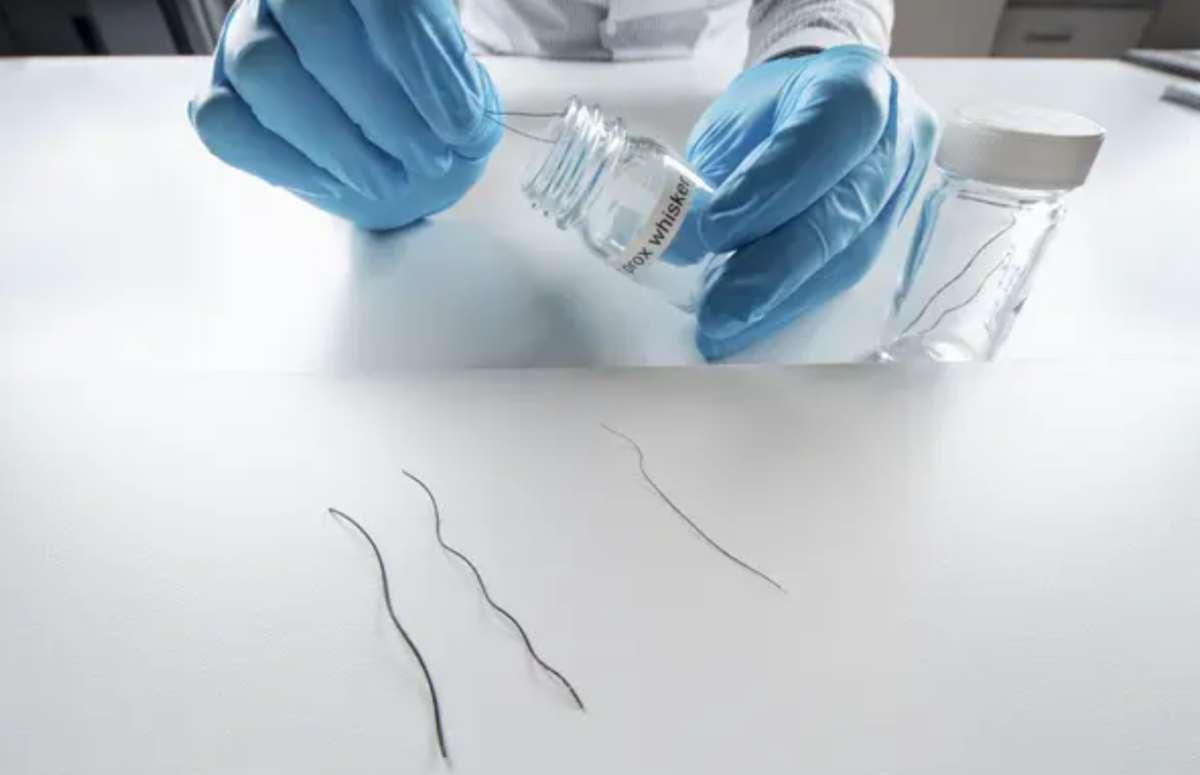
The team of researchers worked to prepare elephant whiskers from various parts of the elephant’s trunk for advanced microscopy and characterization methods
Elephant trunks embody a biology that is probably more sophisticated than the most sophisticated gadget existing. As the giant animal rhythmically sways and brushes the trunk over objects and surfaces, it creates a subconscious map of its environment using tiny touchpoints embedded in the trunk. Called whiskers or vibrissae, these tiny, hairlike touchpoints act as “feelers” that enable a rich sensory experience for the elephant. This amazing sense of touch compensates for their poor eyesight and thick skin.
An elephant typically has 1,000 whiskers on the trunk. Scientists involved in the study investigated these whiskers from the standpoints of geometry, porosity, and material stiffness with the accuracy of one billionth of a meter. Their analysis revealed that the trunk is actually an organ exhibiting a fascinating sensory gradient with high functional intelligence. The base of the whiskers was found to be as hard as plastic, while the tip was as soft as rubber, quite similar to the whiskers of cats but distinct from those of rats.
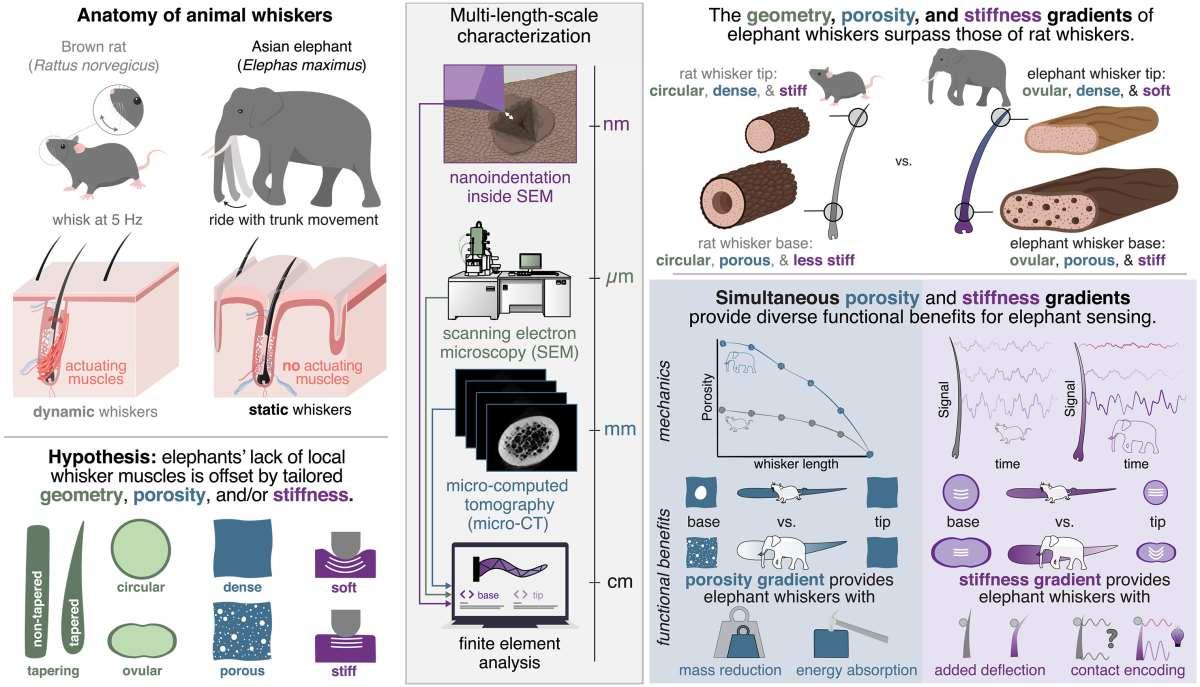
Functional gradients give elephant whiskers physical intelligence
The study was a collaborative effort of researchers from the Department of Haptic Intelligence at MPI-IS and research teams from the Humboldt University of Berlin and the University of Stuttgart. The team conducted the research by combining biomechanics, haptics, neurobiology, and advanced materials. Micro-computed tomography imaging revealed that the whiskers have a hollow base, flattened cross-section, and several long internal channels that resemble the structure of sheep horns and horse hooves. The suite of tools also included electron microscopy, mechanical testing, and finite element analysis.
From the observational data, they proposed that elephants lack local whiskers. Their unusual tapered ovular geometry and grass-like shapes allow them to bend from a porous base to a dense tip. This particular geometry also facilitates contact encoding along the whisker.
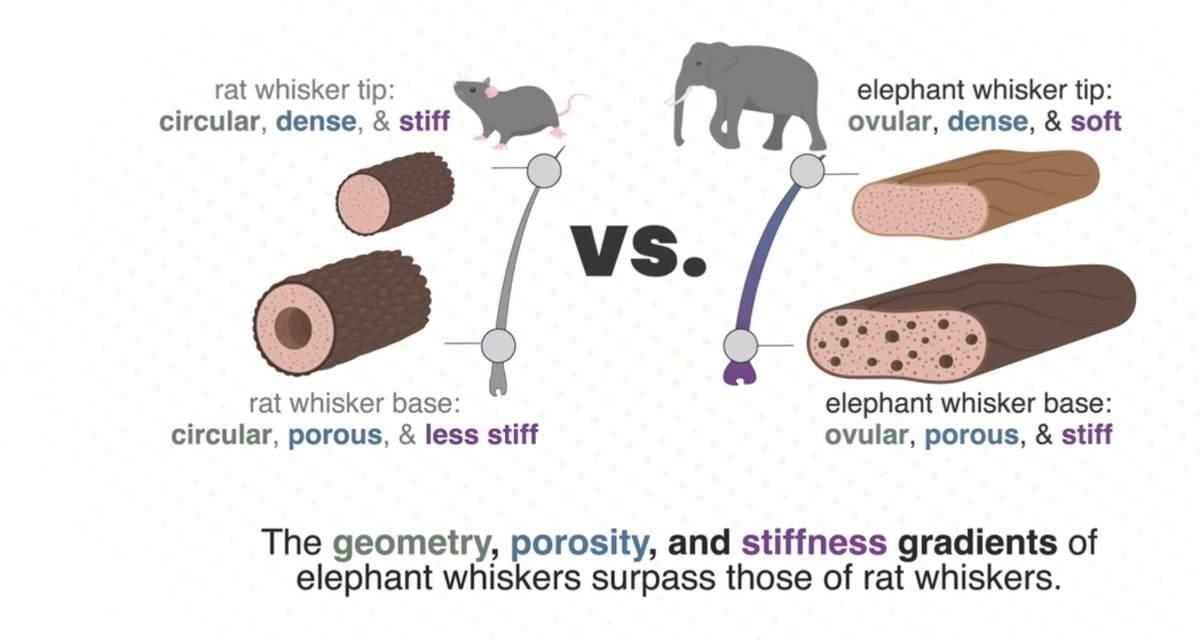
Scientists found how the whiskers in elephant trunks are distinct from those in rats
In the next step, they designed the wand that was later tested by Kuchenbecker. The objective was to see how whiskers reacted to different points of contact. The team later explained in a video that the porous base reduces their mass and helps absorb energy during all contacts that happen.
“The findings will be used in the development of robot-assisted sensor technologies that mimic the stiffness gradient of elephant tactile hairs,” he announced. Echoing the excitement, Dr. Michael Brecht, at the Berlin Zoo, exclaimed to SBS Australia, “It is truly one of the best things nature has developed!” Meanwhile, neurobiologist Lena Kaufmann, who was also strolling around the same zoo, came across an adorable elephant named Anchali. Anchali extended her long trunk and enveloped Kaufmann in a hug, proving once again that nature is the source of all science.