
When a Pianist Sat Down To Play For Blind Elephants No One Imagined How Deeply They Would Connect
Published Aug. 6 2025, 8:45 a.m. ET

British pianist helps elephants heal by playing classical music
Just outside Kanchanaburi in Thailand, a truck loaded with an acoustic piano crosses the meandering waters of the River Kwai. After reaching its banks, the piano is transported to a field carpeted in banana grass, where Ampan arrives every morning to have her breakfast. Today, she is not alone. Paul Barton (@paulbartonpiano), the British pianist, is trundling alongside her. Barton puts down his orange rucksack and embraces Ampan on her trunk, then takes his seat in front of the piano to play Debussy’s Clair de Lune. By the time he is finished playing the song, Ampan’s eyes are glistening with tears.
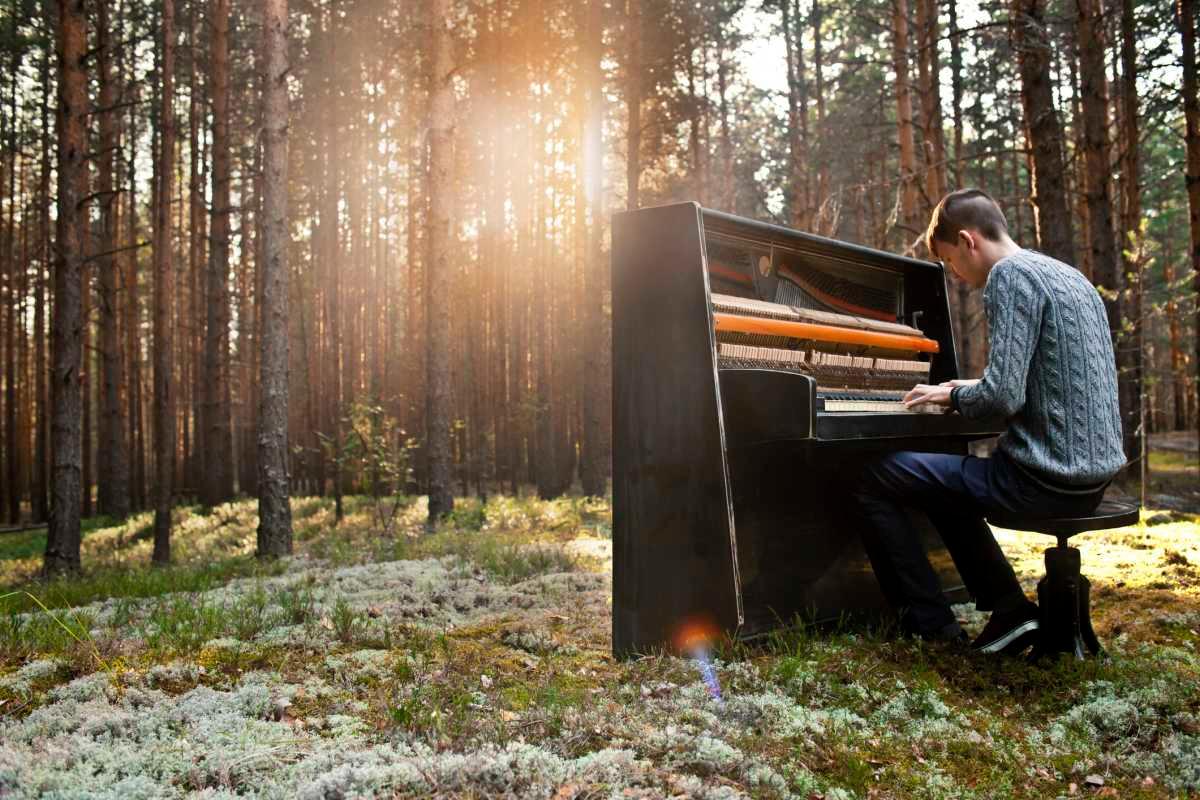
Man playing piano in a jungle
Almost 80 years of human-induced labor has reduced Ampan into a shard of trauma, the evidence of which can be observed in her eyes. One of her eyes is trapped in the world of darkness. So while Barton plays the piano, every tap of his fingers on the black-and-white keys seems to stir something inside her as she stands beside him. The giant elephant cries, listening to Barton's soulful rendition. The resonant gradient of rhythm, the rippling arpeggios, the low timbre, and the circle of melody; the trail of musical elements appears to evoke the pain she had gone through over all these years.
Another video captures Barton playing piano for a 61-year-old elephant, Mongkol. Mongkol spent years hauling heavy trees in Thai forests, his body shape deformed by carrying the weight. A brutal logging project stole away part of his tusks and right eye, leaving him trapped in an irreversible suffering, just like Ampan. So, all he does these days is rest, relax, and meditate on the shores of Kwai. Barton visits him one night to play Beethoven’s Moonlight Sonata, the soft, undulating melody of lamentation expressed through reverberating triplets.
Mongkol stands, close to Barton, immersed in the haunting and hypnotic melody mirroring the moonlit stillness around them. As the sonata transitions into the sombre notes, expressing sadness and mourning, the elephant bobs his head sideways, looking at Barton seated on the piano. Like Ampan, she too seems to be enjoying and healing through the classical tune, as apparent by her flapping of ears and coiling of trunk. By the end, his eyes are too moist with tears.
Barton stands up from his seat and touches his forehead against Mongkol’s trunk, rubbing it with emotion. Barton has played music for hundreds of these elephants, and every episode is drenched in intense emotion. His soulful tunes make these hard-working giants shed tears like babies. It started in his 30s when he visited Thailand and met his wife. His wife was an artist who made elephant sculptures at an elephant sanctuary called the Elephant’s World.
On his 50th birthday, she urged him to try playing music for these animals and observing how they responded. Many of them had been mistreated and were now living in pain. But each time Barton starts the song, the elephants find it soothing, healing, and loving, probably for the first time in their life. He has made lasting friendships with these beasts, as she told BBC World. “Their breathing actually slows down when you play, which tells me they are relaxed and happy,” Barton shared with The Guardian.