
AI Finds Tiny Yellowstone Quakes Once Missed by Scientists, Revealing Hidden Swarm Patterns
Published Dec. 3 2025, 8:39 a.m. ET

A couple enjoying the beautiful view of a geyser in Yellowstone National Park.
It might sound uncanny to the millions of people who walk these grounds each year, but Yellowstone sits atop a restless inferno that is constantly rumbling with excitement. A complex dance of hydrothermal fluids, simmering water, and hot gases happening beneath the Yellowstone caldera keeps triggering earthquakes time after time. While some of them are felt in idiosyncratic sensory detail, others often go unnoticed due to their subtle, undetectable nature. Recently, scientists at the Yellowstone Volcano Observatory and the U.S. Geological Society conducted a study to map out the hidden patterns of movement these earthquake clusters imprint upon the rocky curves of the agitated, deep-seated world. Findings are published in Science Advances.
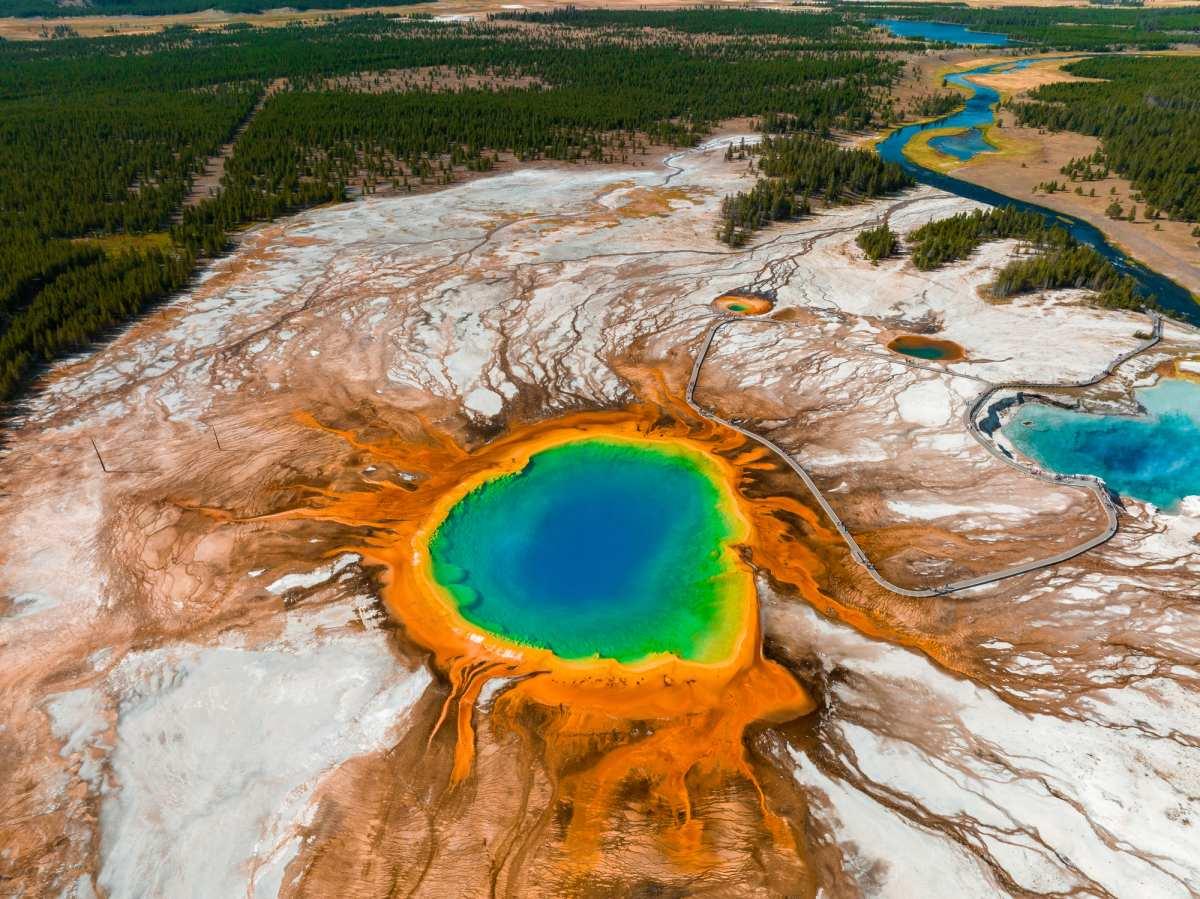
Crater of Yellowstone supervolcano
Yellowstone is one of the most seismically active regions across the United States. The caldera tucked within the landscape is familiar with the sudden awakenings of the crustal grounds into thunderous explosions and terrifying quakes. The region has been experiencing earthquakes almost regularly for the last decade. When they pass, the earthquakes, both big and small, leave patterns beneath the surface that, when detected, can unlock a precious library of information about the array of processes that might be unfolding underneath. The rocks underneath are like the Yellow Pages that compile the details of every earthquake that flitted through the region.
Some earthquakes are easily detectable, while others are too subtle to be felt by humans standing above. That’s why scientists have positioned a set of seismometers, both above and under the surface, spread across the dense landscape of the park. These seismic stations can record the most subtle of sensations that the ground goes through while it breaks apart or explodes into seismic activity.
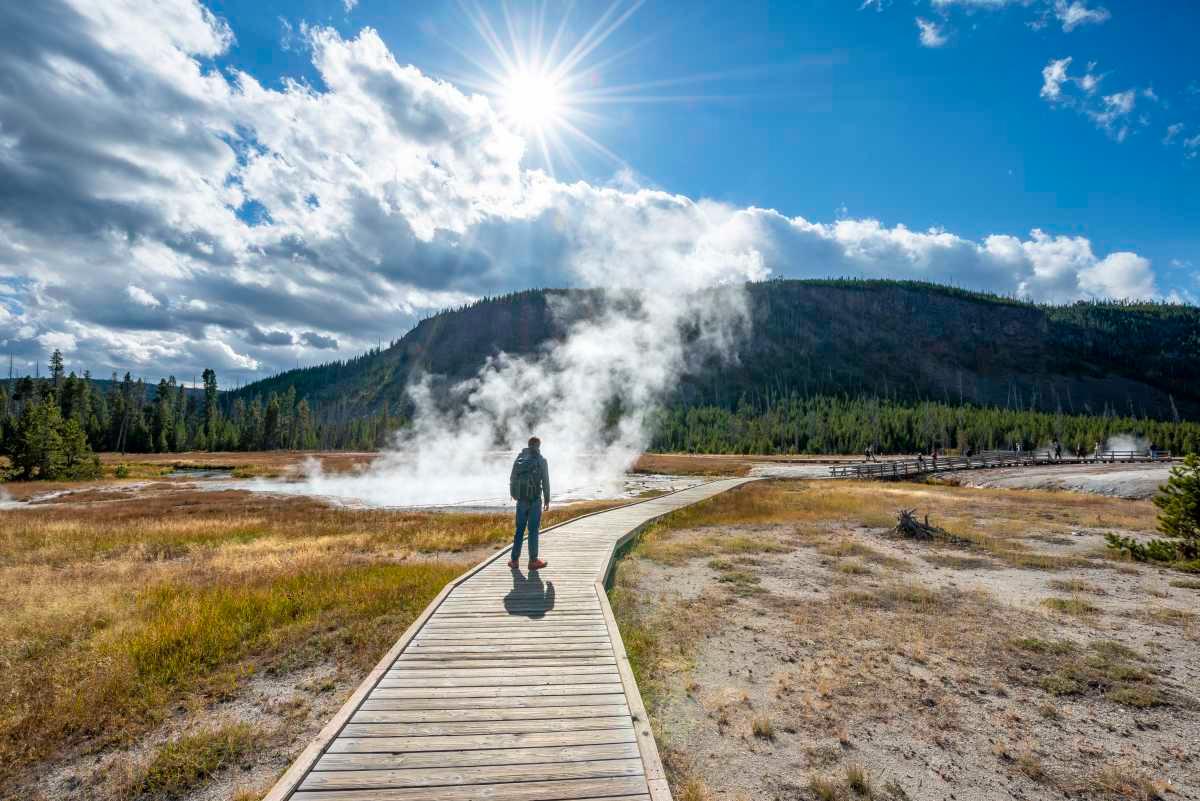
A tourist walks in front of a steaming hot spring in Yellowstone National Park
The belly underneath Yellowstone’s ground is in constant motion. This motion, however, is composed of highly complicated patterns of movement that have been programmed by the clusters of earthquakes that have erupted in the last few years. The story always goes like this. Up until 5 miles under the ground, hot water, gases, and fluids continue to seep along fractures. The moment they strike a sealed zone, pressure starts to build. Eventually, this pressure forces the rock to crack. As the surrounding rocks crack, the fluids provoke the entire fault system. Bursts of seismic energy are released. Some of these pockets of energy are felt as earthquakes, but the rest of the energy becomes trapped in this underground belly, waiting to be provoked again.
For some time, everything quietens down until the whole string of events repeats itself. This “stop-and-go process,” as researchers describe, carves a rhythmic pattern of earthquake swarms. Scientists study the details of the cluster geometry to understand these rhythms and patterns. Many earthquakes are routinely detected and located by the University of Utah Seismographic Stations (UUSS), but it doesn’t provide sufficient data for scientists to make a satisfying earthquake catalog. In this study, they analyzed 15 years of seismic data from 2008 to 2022. To compute the data, they utilized a different approach, never used before for this kind of study.
To squeeze out important details from a huge 15-year-spanning dataset, they used a machine learning approach, which helped them identify seismic phase arrivals in the form of raw, continuous seismic waveforms. The resultant earthquake catalog for 2008–2022 contained 86,276 events, more than 10 times as many as included in the routine earthquake catalog. The catalog revealed a fascinating snapshot of Yellowstone’s hydrothermal, tectonic, and volcanic story.
At a depth of 5 miles, they noticed, the seismic activity stopped. The infernal world went quiet, suggesting the presence of partially molten rock that absorbs energy rather than fracturing. This study, scientists say, is a turning point in how they will now study seismic movements across volcanic regions.