
2,300-Year-Old Celtic Gold Coins Discovered — Experts Question Their Use as Currency
Published Dec. 23 2025, 2:18 a.m. ET

Treasure hunter found an ancient gold coin buried in the ground
Until around the middle of the third century BC, Celtic people mostly carried out their everyday transactions using a barter or payment-in-kind system. They exchanged items like grains, textiles, metalware, salt, small properties, gold rings, iron bars, bell-shaped tokens, or animals for buying food and essentials. But then, something shifted. The Celtic warriors who ventured out into Greece to fight battles found something that dramatically reconstructed the Celtic economy.
These warriors would come back home bringing the idea of money with the wages they were paid for fighting in Greece. Over the following years, the Celts started minting their own coins by imitating the Greek coins they had. According to a recent press release, two Swiss archaeologists have stumbled upon what they believe are Celtic gold coins from this period.
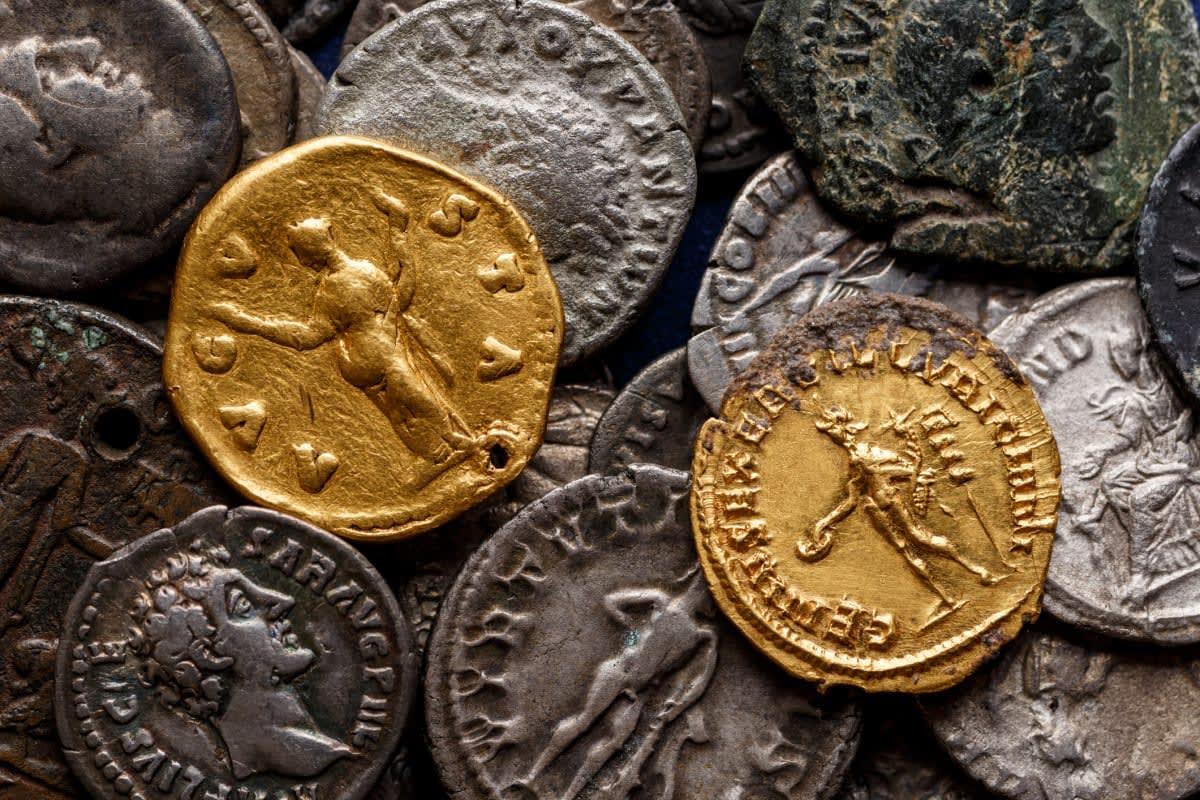
Two ancient gold coins sitting on a hoard of silver coins
The discovery was made by happenstance, prompted by a 2023 finding. In 2023, archaeologists found a trove of 34 Celtic silver coins dating to 80 to 70 BC. They unearthed it from the Bärenfels area near Arisdorf. The discovery kindled the curiosity of archaeologists Wolfgang Niederberger and Daniel Mona from the Archaeology Department of Basel-Landschaft. In the spring of 2025, they embarked on a follow-up investigation in the same area, a wooded landscape in a Swiss bog. In all innocence, their hunch proved right.
Lurking within the bog’s marshy wetland were two Celtic gold coins: one stater and one a quarter stater. Staters were the coins Celts started creating after being inspired by the Greek currency that warriors brought back home after wars. Coin expert Michael Nick of the Inventory of Coin Finds of Switzerland (IFS) examined the dough and identified the stater as the Gamshurst type and the quarter stater as the Montmorot type. The Gamshurst stater weighs 7.8 grams or 0.27 ounces, and the quarter stater weighs 1.86 grams or 0.06 ounces. These pieces, the researchers say, are some of the “oldest Celtic coins from Switzerland,” belonging to the very small group of just over 20 known examples.
Hand holding a scoop of silver coins from a stash full of coins
The newfangled treasures illuminate stories of the monetary systems in Central Europe at this time, particularly of the Celts. Around 2,300 years ago, the Celts launched their own coinage, beginning with imitations of the gold coins of the Macedonian king Philip II (359–336 BC), the father of Alexander the Great. The artwork etched on the coins depicts the head of the Greek god Apollo on the obverse side, and a two-horse chariot called biga on the reverse side. However, the art on these coins is slightly different from the Greek originals. Live Science noted that on the smaller one’s reverse, a triple spiral can be seen beneath the horse. Known as a triskele, this symbol is a common motif observed in Celtic art.
But seeing that the coins seem too valuable to be used in everyday transactions, archaeologists suspect that they could be used instead for purposes other than daily billings. For instance, as diplomatic gifts, political exchanges, dowries, or symbolic rewards. Another clue is the location where most of these coins have been observed by various archaeologists. Most of the coins have been discovered in or near graves or water-filled bodies like rivers, bogs, sinkholes, and wetlands, which suggests that they could be serving a ritualistic purpose, such as offering to the gods.

Sunlight sparkling through a bog
The two newfound gold coins, together with the roll of 34 silver coins found in 2023, will be displayed in an exhibit titled “Treasure Finds,” organized by the Archaeology Department of Basel-Landschaft and the Basel Historical Museum. The discovery also opens up a new range of possibilities for those who are fascinated by historic artefacts. The next time you are strolling near a forest pond or wetland, pay attention. You too may hit upon a prehistoric jackpot.