
Why Did Punch the Viral Monkey Adopt an IKEA Plushie as His Mother? A 1957 U.S. Experiment Explains
Published Feb. 27 2026, 3:42 a.m. ET

(L) Punch with his orangutan plushie (R) American researcher Harry Harlow’s Experiment (Cover Image Source: (L) X/@ichikawa_zoo | (R) American Psychologist, 13, 673-685)
Seven-month-old Punch clings to the orange-bodied "Ora-mama," his arms firmly clasped around her neck. Having been abandoned by his own mother, he can’t afford to let his new mom go. These days, IKEA’s orangutan plushie is his only source of catharsis, of soothing his emotional pain. Many days, he can be seen dragging the plushie around, across the rocks and rugged cliffs, as the bigger monkeys in the troop try to bully him. However, his recent videos suggest that the troop is beginning to embrace and befriend him. Thanks to IKEA’s plushie, love is bubbling in Punch’s heart once again, and he is regaining his playfulness, a demonstration that psychologists and therapists are relating to a set of 70-year-old experiments that American researcher Harry Harlow conducted on primates.
Punch is a baby macaque living in Japan’s Ichikawa City Zoo. Soon after he was born, his mother abandoned him. Then, he was rejected by the rest of the troop. For the first few days, he struggled to gel with the zoo's monkey troop. For days, he would refuse to eat on his own. He walked around, isolated and dejected. On the internet, his grief and quest for love left people heartbroken, who are expressing their sentiments with sobbing GIFs and tearjerking remarks. “I just want to hug him,” a viewer wrote on Instagram. In response to a video where Punch was being bullied by adult monkeys, one viewer wrote on Reddit, “Not to be dramatic but I will die for this little monkey.”
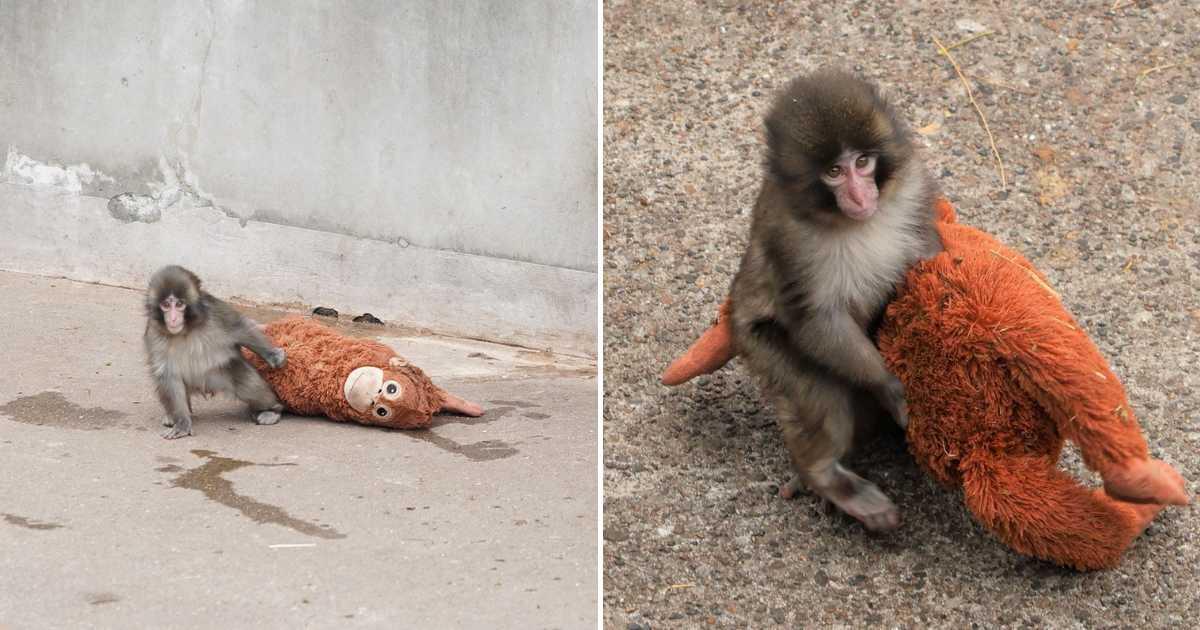
Seven-month-old Punch, the viral Japanese macaque, is pictured with his plushie at Ichikawa City Zoo. (Image Source: (L) Facebook | Ichikawa City Zoo; (R) X | @ichikawa_zoo)
Back in the zoo, seeing him in this condition upset the staff members. Partnering with IKEA Japan, they gifted him this orangutan plushie believing that it would help him regain muscle strength and have some emotional comfort from his lingering feelings of abandonment and rejection. For psychotherapists and behavioral scientists, Punch’s heartbreaking story is classic evidence of what Harlow attempted to prove with his experiments in the 1950s, suggesting the importance of emotional presence in addition to physical nourishment.
Harlow took rhesus monkeys at birth and separated them from their mothers, as The Conversation explains. The monkeys were raised in an enclosure where they had access to two surrogate 'mothers,' but not their original one. One of those was a wire cage that was shaped in the form of a 'mother' monkey, which had a feeder that provided the monkeys with food and milk. The other one was a monkey-shaped doll wrapped in terry towelling. Although the doll was soft and comfortable, it didn’t provide any food or drink. It was something that the monkey could cling to for comfort.
From a behaviorist point of view, the baby monkeys should have preferred the "wire cage mother," as it took care of their survival needs. Contrary to that, Harlow observed that the monkeys tended to gravitate towards the "terry towelling mother," even though it didn't offer them any sort of physical nourishment, suggesting the importance of emotional connection in close relationships.
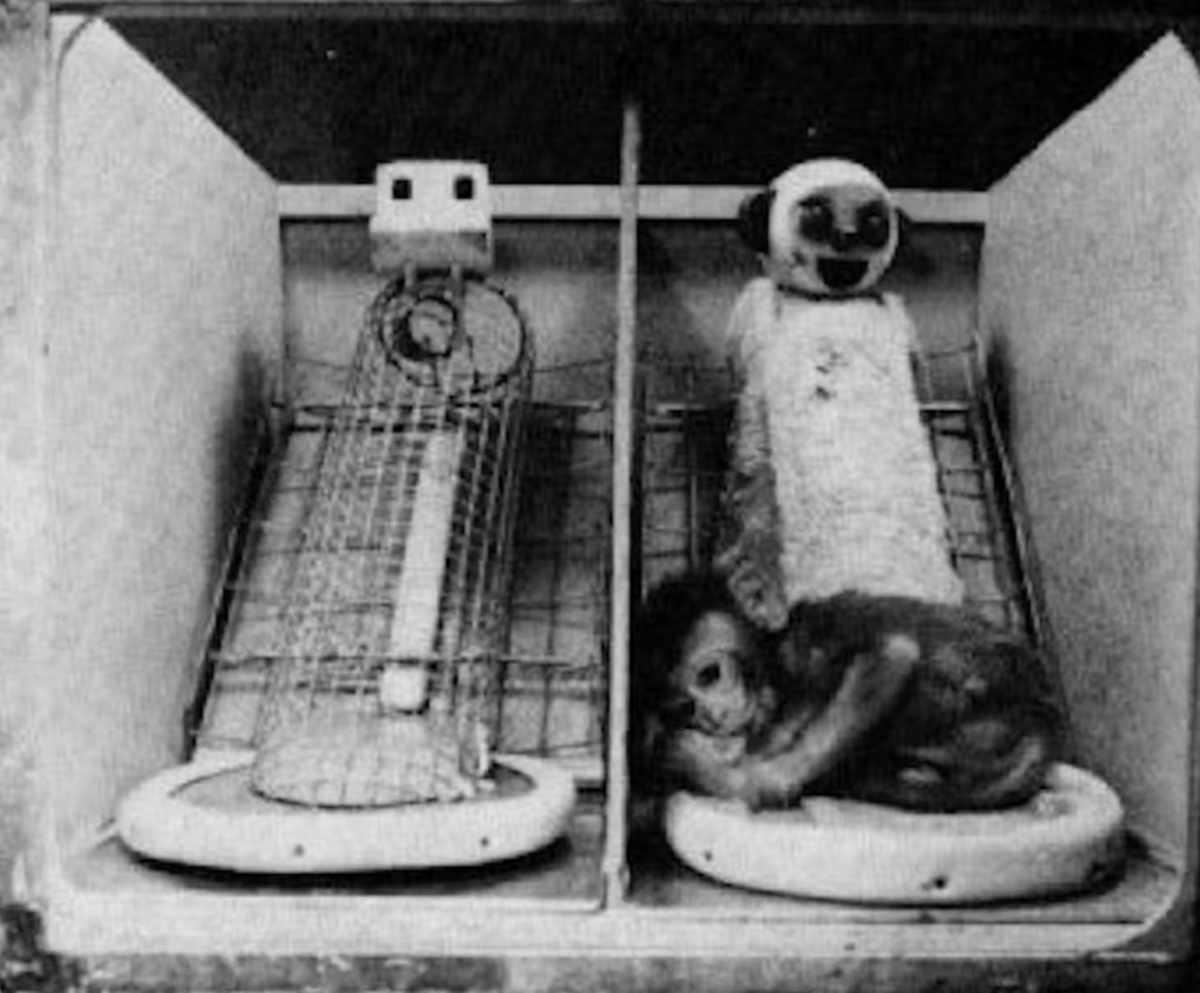
Wire and cloth mother surrogates offered to a monkey to help him handle the feeling of abandonment and separation
Reflecting on the experiment, primate expert Luke Duncan shared with Huffington Post that Harlow’s experiment demonstrated that “tactile comfort is a powerful driver of attachment behavior in infants.” The experiment was a masterclass in behaviorism that suggested that babies need more than just the fulfillment of their biological needs. They need secure emotional attachment, care, kindness, and love, rather than just physical nourishment. “Young primates are biologically programmed to cling to their mother ― it’s a normal and essential part of emotional and psychological development,” said Duncan. Relationship therapist Sofie Roos added how plushie toys like these can be a great resource for “cuddle therapy” in humans as well.
While the “Ora-mama” will never replace Punch’s original mother, it may, to a great extent, offer him healing from the persistent feelings of loneliness, insecurity, stress, and anxiety. In the meantime, he always has the love of millions of people who’re watching him. As IKEA Switzerland put in an Instagram caption, “Sometimes family is who we find along the way.”