
This Mysterious Jurassic Fossil May Sit at the Root of Snake Evolution
Published Dec. 29 2025, 4:24 a.m. ET

Giant lizard sticking its tongue out for preying
In 2016, Museum Macaulay Curator Roger Benson was exploring limestone blocks in the village of Elgol in Southern Skye. His colleagues asked him to give up, believing that they had left no spot unexplored and weren't likely to discover anything valuable. Benson had only walked about 15 feet when his attention fell on something unusual etched into a block of micritic limestone. They extracted the block and couldn't believe what they had just found: the skeleton of a prehistoric reptilian creature, which was part snake and part lizard. The discovery unlocked a whole new trove of questions in the jigsaw puzzle of reptilian evolution. In a study published in Nature, Benson documented that this chimeric reptile could be one of the first snakes to have emerged on the planet.
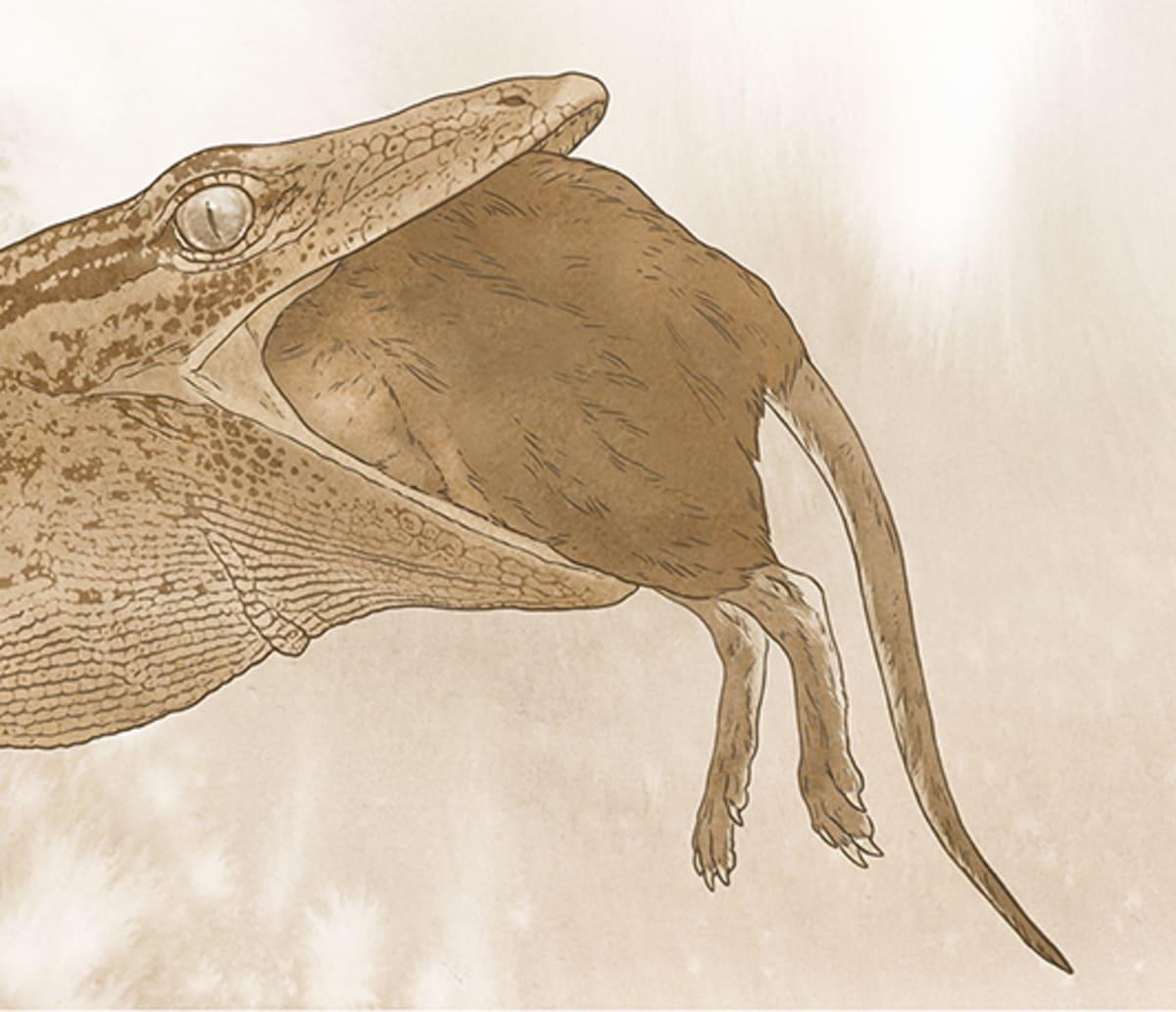
A visual depiction of Breugnathair elgolensis, the false snake of Elgol that scientists recently discovered in Southern Skye. The reptile is devouring a mammal whole
The discovery erupted almost like accidentally venturing into a forbidden lair and being greeted by the hiss of a tantalizing serpent goddess. In this case, scientists aren't sure whether it was truly a goddess—or a mix of God and goddess wrapped into one wiggly package. Measuring nearly 16 inches long from head to tail, this reptile led scientists to wonder whether it was a lizard-like ancestor of snakes or a snake-like predecessor of lizards. The reptile shows a curiously confusing anatomy, with one portion of its body resembling a snake and the other resembling a lizard. Scientists nicknamed it "Breugnathair elgolensis," the Gaelic translation for "false snake of Elgol."
This neoteric beast belongs to the family of squamates, a term scientists use to define the collective category of lizards and snakes that roamed the planet over 190 million years ago. They listed it in the parviraptorids, an enigmatic family of reptiles featuring mosaic anatomy, which remains a long-standing subject of scientific debate. Its teeth and jaw resemble those of pythons, its head and body proportions are similar to monitor lizards, and it has some primitive traits similar to geckos.
Depiction of a prehistoric reptile
The study was a multinational collaboration between the American Museum of Natural History and scientists from the United Kingdom, France, and South Africa. They utilize a constellation of reconstruction methods, investigative tests, and examining technologies to scrutinize every jot and tittle of the reptilian specimen. For testing, they also separated portions of the fossil into little blocks inside a university laboratory in Bristol. X-ray tomography and pilot CT scans were conducted for analysis in the European Synchrotron Radiation Facility in France.
The specimens were mounted on frosted glass slides with clear Gorilla superglue gel, and images were recorded with two Hasselblad lenses for high optical clarity. The conflict that the reptile displayed in its morphology and molecular phylogeny left scientists scratching their heads with an army of questions, some of which are still unanswered. They proposed that parviraptorids, like this chimeral creature, could be the earliest members of the stem snake lineage. Bone histology revealed nine distinct growth marks indicating a minimum age of nine years.
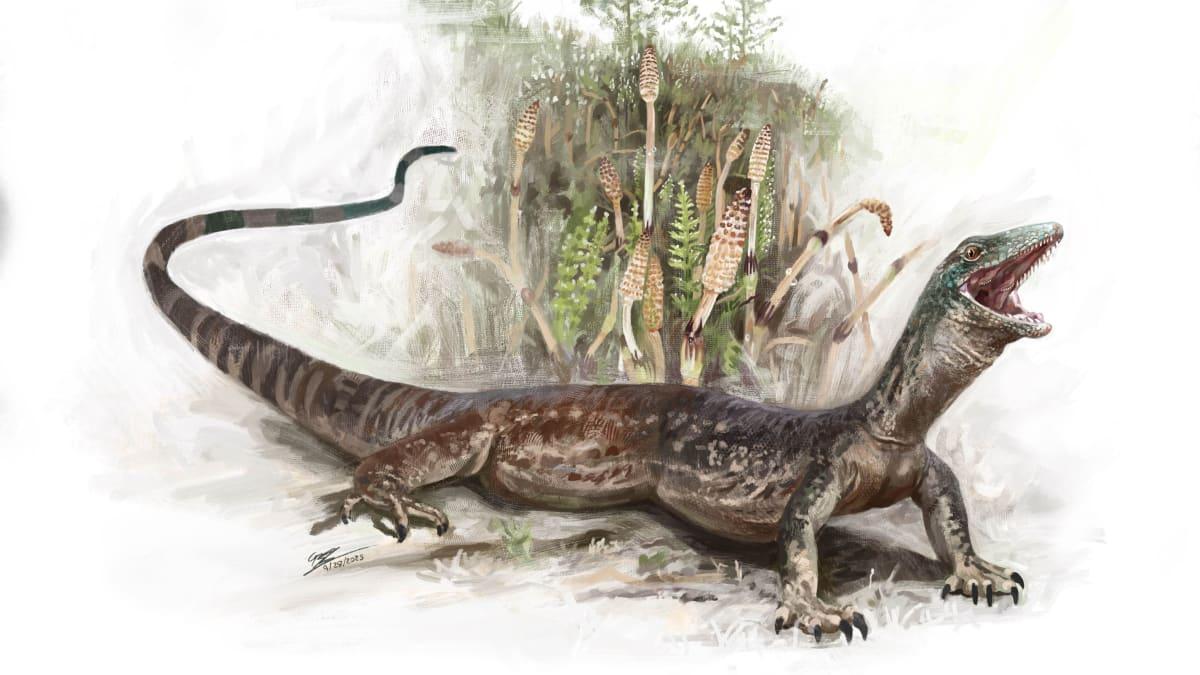
A visual depiction of Breugnathair elgolensis, the false snake of Elgol, scientists recently discovered in Southern Skye. The reptile is half lizard and half snake, nearly 16 inches long
"Snakes are remarkable animals that evolved long, limbless bodies from lizard-like ancestors," Benson reflected in a press release. "This might be telling us that snake ancestors were very different to what we expected, or it could instead be evidence that snake-like predatory habits evolved separately in a primitive, extinct group."
Susan Evans, co-author of the study, exclaimed that the discovery is like "finding the top of the jigsaw box many years after you puzzled out the original picture from a handful of pieces." The specimen, she added, is a reminder that "evolutionary paths can be unpredictable." The hypothesis about stem snakes or parviraptorids is incomplete because of insufficient information. "This fossil gets us quite far, but it doesn’t get us all of the way," Benson said. "However, it makes us even more excited about the possibility of figuring out where snakes come from."