
Spain and Portugal Aren't Exactly Staying Put. Scientists Say the Ground Beneath Is Slowly Turning
Published Feb. 16 2026, 3:59 a.m. ET

The city lights of Spain and Portugal define the Iberian Peninsula in this photograph from the International Space Station (ISS)
Earth’s crust is a jigsaw of pieces that float atop the roiling liquids churning within the mantle. When these pieces, a.k.a. tectonic plates, move, their dance provokes continents to move farther or closer. Seas open and close. As feral forces compete to shape the Earth’s crust with their own geometry, the tensions relax through earthquakes or volcanic eruptions. The motion is usually slow and messy. Below your shoes, the ground may appear stationary, but deep within the dark understory, it is quietly stirring up for a new performance. As the plates get jumpy and start banging and shaking their edges with one another, they create zones where stress gets trapped and distributed.
In a study published in Gondwana Research, scientists documented a bizarre tectonic dance happening in the Iberian Peninsula. Sandwiched between the African and Eurasian plates, this piece of Earth’s crust is slowly rotating clockwise. "Every year the Eurasian and African plates are moving 4-6 mm [0.16 to 0.24 inches] closer to each other. The boundary between the plates around the Atlantic Ocean and Algeria is very clear, whereas in the south of the Iberian Peninsula the boundary is much more blurred and complex," said Asier Madarieta-Txurruka, a geologist from the University of the Basque Country and a researcher in the EHU’s Water Environmental Processes Group (HGI).
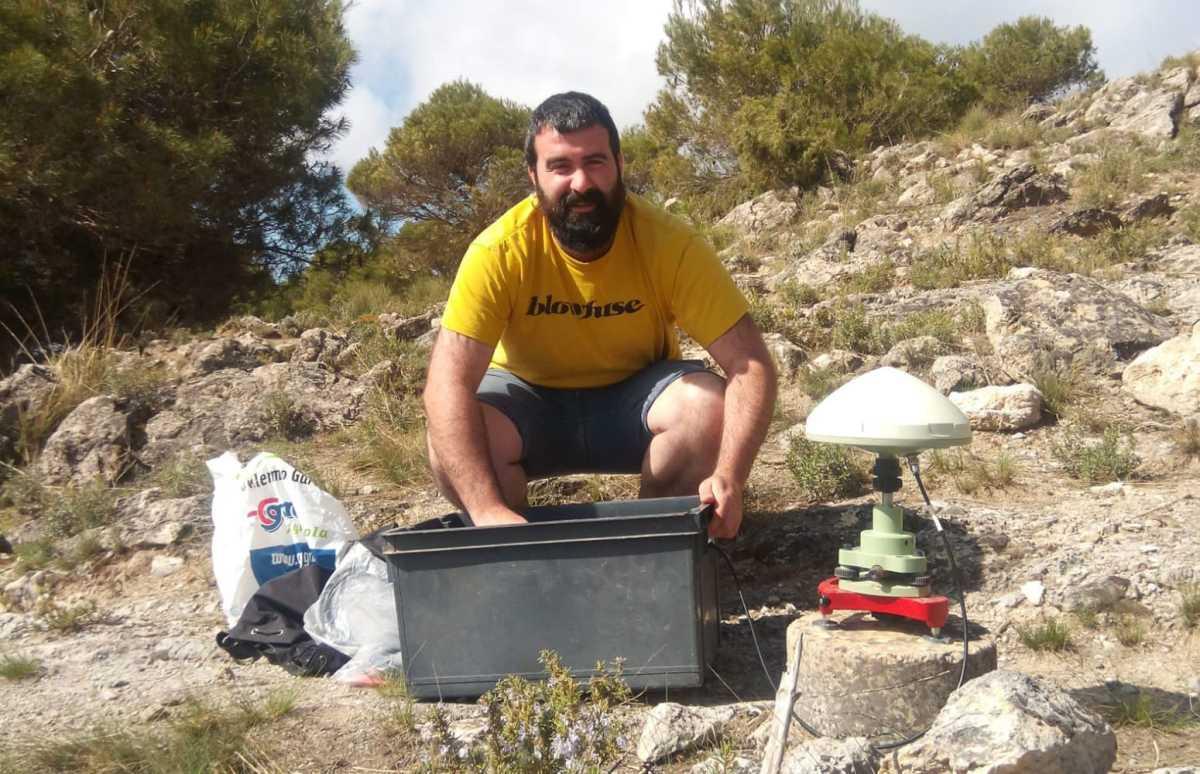
Asier Madarieta, researcher at the University of the Basque Country (EHU), installing a Global Navigation Satellite System (GNSS) network in the Betic Cordillera
The Iberian Peninsula is situated in southwestern Europe, mainly composed of Spain and Portugal. After hugging the northern shore of the African continent, the piece juts out into the ocean. Above all things, its southern edge is the most mysterious. The Gibraltar Arc, the tight mountain chain that forms the boundary between the Mediterranean and Atlantic, is a highly complex and active region of seismic activity. The objective of the scientists behind this research was to meticulously investigate the folds, faults, and rollbacks in the tectonic plate to determine whether it carries a potential for earthquakes in the western Mediterranean in the near future.
Since Iberia acts as a genetic bridge between the African and Eurasian plates, scientists wanted to understand how the mysterious rotation of the Iberian plate would impact the regions along Africa and Eurasia. The question prompted them to seek help from satellite observations and earthquake record catalogues to understand what’s really going on within the Earth’s crust. Like two slow-motion cars approaching each other into a crash, the two plates were likely about to crash into each other. While earthquake records provided them a crisp snapshot of forces churning within the crust, satellites and geopositioning sensors provided them information about surface deformations, from minute to major.
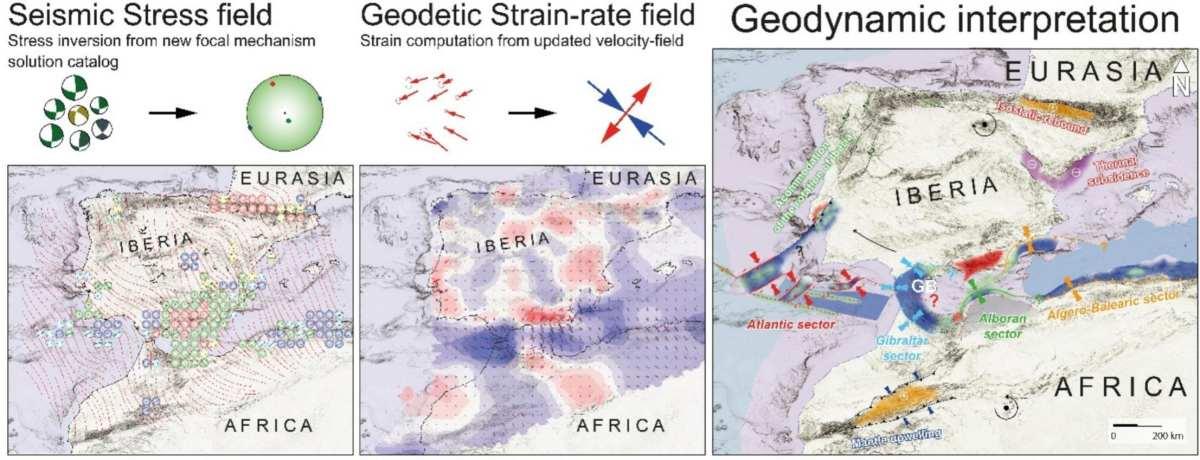
Graphical abstract of stress-strain dynamic unfolding in Iberian Peninsula
The team, led by Madarieta-Txurruka, studied the seismic screams reverberating through the tectonic plates to gain insight into how stress travels through the crust and how the surface responds to the stress through warping, bending, or breaking. As pressure builds up, these little deformations materialize as clues to how much stress is lingering under the ground and whether it is developing a mood for an earthquake. If yes, then scientists must be aware of the upcoming threat. “These stress and deformation fields tell us where we have to go to look for these structures,” Madarieta said in the press release. “And that way, we could find out what kind of folds and faults there may be, what their movement would be like, what kind of earthquakes they could cause, and of what magnitude.” However, understanding which geological structure is triggering the deformation wouldn’t be easy, he confessed.
Perhaps, by building a more comprehensive database of active Iberian faults and integrating multiple datasets, they can solidify their confidence in these research models and calculate the geometry of deformations even in the most poorly accessible areas. Meanwhile, the rotation of the Iberian plate is so slow that it will probably take millions of years for the African and Eurasian plates to collide into each other. But deciphering the intriguing dynamics will at least keep scientists updated on whether there are any massive quake threats lurking down there.