
Russian Startup Tests Hacking Pigeon Brains to Develop First-Ever 'Bio-Drones'
Published Feb. 11 2026, 8:05 a.m. ET

Biodrone.
Pigeons are regularly found flying around in different kinds of surroundings. No red flags are raised when they are spotted in any urban environment. However, a Russian startup is trying to take advantage of this. A startup named “Neiry” has developed a technology that can access the brains of these birds and turn them into biological drones, according to Gizmodo. The technology is a neural implant that delivers “mild simulations,” encouraging the pigeon to take up certain paths.
Experts compare this action to hacking. The new technology has already been tested on a flight of pigeons. The company technicians insert tiny electrodes into the bird’s skull, linked to a stimulator on its head, to facilitate data transmission. During these evaluations, the pigeons were provided with a small controller, solar panels, and a camera. Through the camera, officials get a view of the paths undertaken by these birds.
The camera's size is similar to the ones already installed in public spaces, according to Neiry. The interface supplies mild simulations to only certain brain regions. Researchers claim that the interface triggers the brain region to choose a particular direction. The system guides the birds towards a preset route. If users activate imaging in the setting, identifiable features of the area are filtered out on device. This is done in accordance with the privacy regulations.
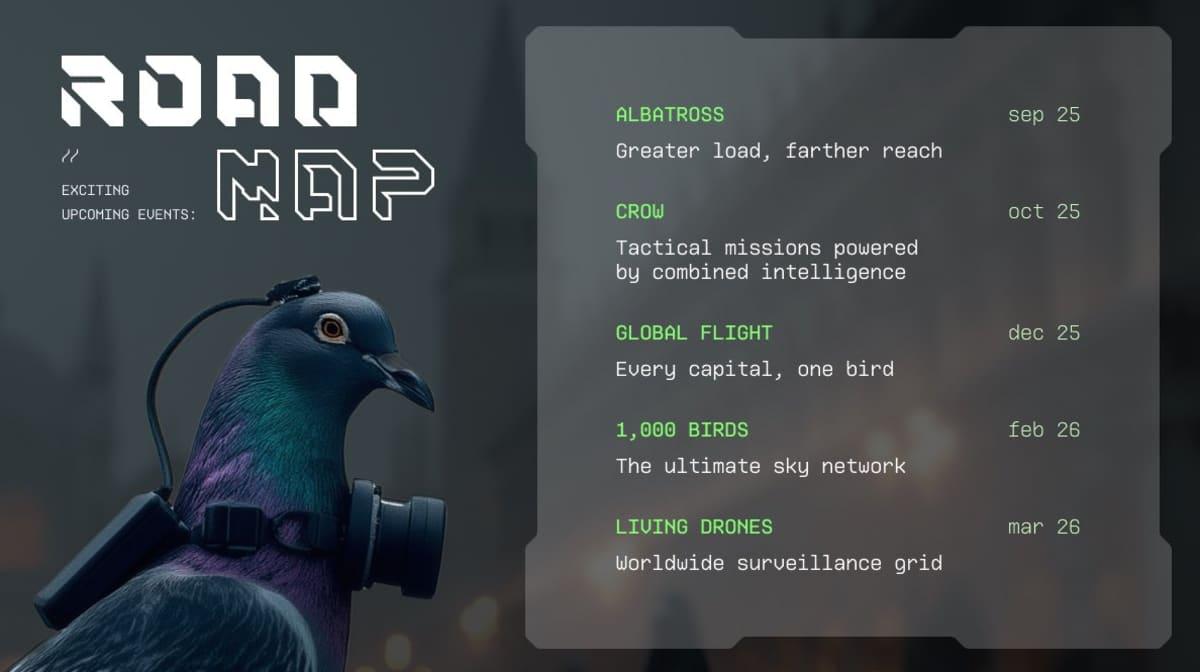
Neiry's roadmap for its bio-drones project
The limited test flights were performed in Russia and the Commonwealth of Independent States (CIS). The objective was to understand the distance these bio-drones can cover, their stability, and the quality of the data transmission. Apart from the test flights, the pigeons followed their normal routine. Researchers ensured that, except for encouraging the birds to select a particular route, the interface does not interfere with any other decision-making. Operators were also caring for the pigeons in between missions.
Despite the assurance, several parties remain concerned. “Any time we’re using neural implants to try to control and puppeteer any species, it feels icky,” Nita Farahany, a bioethicist at Duke University, added. Experts claim that the project labeled “PJN-1” is ready for civilian use. A spokesperson from the startup added that the device has no secondary or concealed use, as many have raised concerns regarding the supposed investment by the Russian government.
The testing is an early real-world use of this new platform. Researchers aim to use these biodrones where mechanical drones face limitations. Biological carriers can succeed in such difficult situations, as they do not require battery swaps or frequent landings. Furthermore, the natural abilities of these birds allow the setup to monitor long distances, something that traditional unmanned aerial vehicles (UAVs) cannot. It is not the first time neural implantations have been performed on birds. However, this is the first time these implantations are being prepared for practical objectives. The start-up believes that the product will sell well in monitoring-intensive markets like Brazil and India.
Researchers believe that the biodrones can be used in remote-area monitoring, coastal and environmental investigations, infrastructure inspections, and search-and-rescue support. Currently, researchers are incorporating the technology only in pigeons, but they are not averse to experimenting with other creatures. “Our current focus is pigeons, but different species may be used depending on the environment or payload,” shared Alexander Panov, founder of Neiry Group. “With the system ready for real-world deployment, this versatility becomes especially relevant in scenarios where conventional drones face physical constraints.”