
NASA Heard a Strange 'Chirping' Sound 62,000 Miles Away From Earth — Then They Realized What It Was
Published Feb. 21 2025, 11:46 a.m. ET

Representative image of a spacecraft in deep space
Miles upon miles overhead, there is a field in the atmosphere that shields the Earth from space energies that could be harmful to the planet’s life. If this field, called “magnetosphere,” didn’t exist, the atmosphere would get eroded by fiery solar winds or it would get blasted with cosmic rays or flurries of charged particles ejected continuously by the Sun. With two doughnut-shaped belt zones, this magnetic field acts as a gatekeeper by trapping charged particles within its belly. But while the deep space is soundless, this field now buzzes with a constant sound that resembles a bird song.
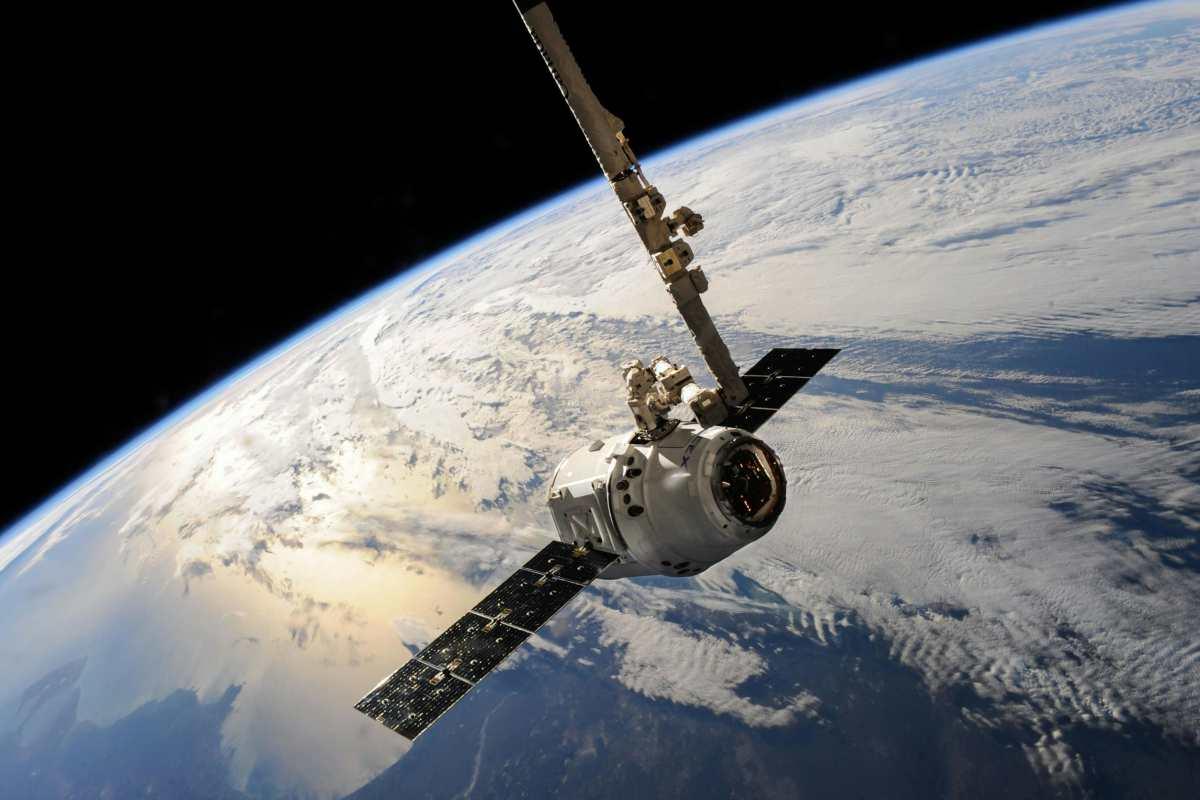
A satellite orbiting around Earth
In a new study published in the journal Nature, Chengming Liu of Beihang University in China and his colleagues reported that these “chirping” sounds are emanating from some of the deadliest electrons whizzing in the plasmic magnetic field. Researchers have observed sounds like this previously as well, but this time it seemed to reverberate from a much longer distance. Their analysis suggested that these sharp notes were coming from a distance of approximately 62,137 miles (100,000 kilometers) from Earth, according to the Associated Press (AP). They referred to these high-pitched bird calls as “chorus waves,” that pulsate in the frequency range of human hearing.
Chorus waves, also called “whistler-mode chorus waves,” are small bursts of energy that last just a few tenths of a second and produce an unusual “chirp” sound that resembles a bird song. “They sound very much like birdsong at dawn. That’s how they got their name,” Richard Horne, a space weather expert at the British Antarctic Survey, told Scientific American. Previously, scientists believed that these waves could only be formed in a dipolar magnetic field, like the one surrounding Earth. This kind of wave has also been observed on Saturn and Jupiter.
Outer space with glittery cosmic dust and sparkling stars
The researchers also attributed this bird chorus to “killer electrons” that dangle in the magnetosphere and have the capability to accelerate at immensely high speeds. “If you’re pumping electrons up to very high energies, you want to know, for crewed spaceflight and spacecraft assets, how many of these killer electrons are in the magnetosphere- chorus waves are very important to understand that,” Allison Jaynes, a space physicist at the University of Iowa who was not involved in the study, told Scientific American.
Colorful sound wave
“They are one of the strongest and most significant waves in space,” Liu explained. Jaynes pointed out, “That opens up a lot of new questions about the physics that could be possible in this area.” The cosmic chirp was picked up by NASA’s Magnetospheric Multi-Scale (MMS) mission. Launched in 2015, this mission used four satellites to track the movements of Earth’s and Sun’s magnetic fields. However, the exact location of this sound’s source is still a mystery to the team.

Earth's magnetic field glowing blue
“This could be occurring anywhere in the universe where there’s a magnetic field, which is just about everywhere,” James Burch of the Southwest Research Institute, the principal investigator of the MMS mission and a co-author of the study, told Scientific American. Since the location of this cosmic chirping is still unknown, scientists are curious to delve into the riddle and raise fresh questions on how this sound actually forms in space far out there. “It’s very captivating, very compelling,” Jaynes emphasized and added, “We definitely need to find more of these events.”