
Google and Microsoft Claim Their AI Models Can Benefit Climate. New Report Says the Proof Is Missing
Published Feb. 20 2026, 4:02 a.m. ET

Overview of Google's AI Mode
Big Tech companies claim that artificial intelligence (AI) will help address climate change, but a recent report rejects that assertion. The report claims that the AI, expected to benefit the climate by reducing emissions, is traditional AI. However, the real harm is posed by generative AI, which continues to gain worldwide momentum. This report was commissioned by a group of environmental organizations, including Beyond Fossil Fuels, Friends of the Earth, and Stand.earth. The study examined 154 statements made by tech companies claiming that AI will have a “net climate benefit.” Experts have determined that through such claims, tech companies are engaging in “greenwashing.”

Gemini AI is seen on a phone.
The benefits cited are mostly associated with traditional AI, which has a smaller environmental footprint compared to the real miscreants, the generative AI, according to Fast Company. Presently, generative AI has led to the establishment of hundreds of data centers, all of which consume significant resources. For years, traditional AI operated as a different entity in a myriad of sectors. Machine learning is already involved in multiple applications that help in mitigating pollution. Now it is being clubbed with generative AI. Both its benefits and damages are proposed as a package deal. Furthermore, the climate benefits expected out of traditional AI have also not been comprehensively proven.
Researchers state that the climate benefits lack scientific backing. The investigations revealed that only 26% of the assistance mentioned in the statements cites published academic papers, 29% was supported by corporate publications, while 36% had no endorsement. Google and Microsoft were two of the biggest names in the group that were found making these doubtful claims.
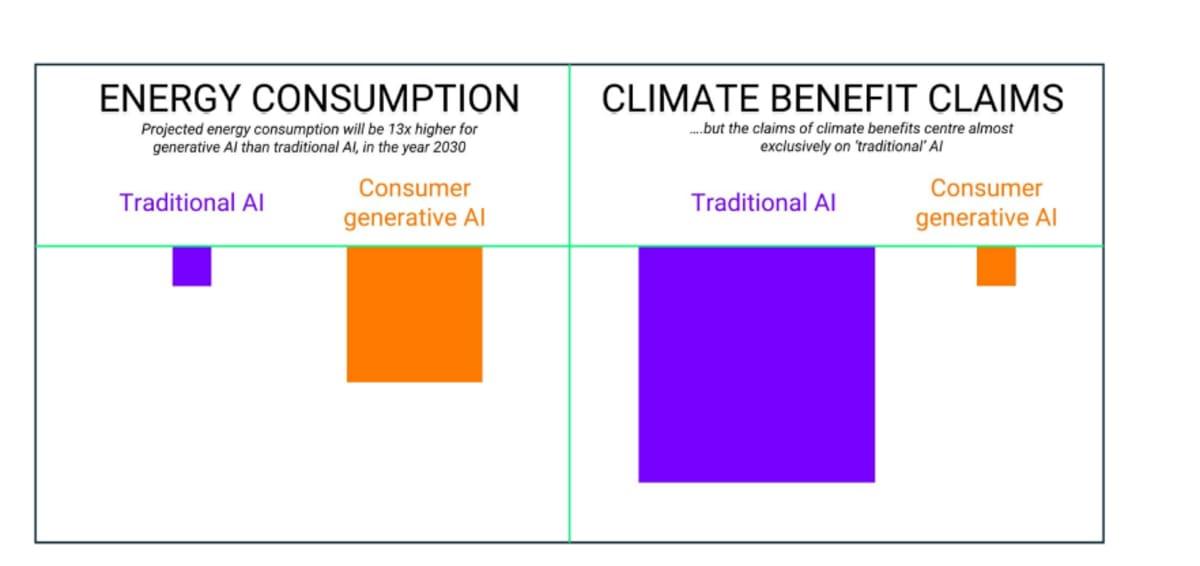
Comparison between different AIs
In late 2023, Google claimed that AI could reduce global greenhouse gas emissions by between 5-10% by 2030, according to WIRED. The claim was substantiated in a paper published by Google and Boston Consulting Group (BCG). This paper was based on BCG’s 2021 analysis, rooted in the company’s experience with its clients. Even after the introduction of platforms like ChatGPT, Google continues to stand behind these appealing emission claims.
Several tech companies have been locked in a competition to develop AI as fast as possible. This competition has increased energy requirements. As a result, several coal plants that may have shut down due to a lack of need are now keeping their shutters open. Gas power worth hundreds of gigawatts will also soon be added to the grid to meet the unexpected demands. Executives use claims like the aforementioned assertion to justify this expansion. They added that the build-out will be worth it, as it will bring several advantages to the planet. Jeff Bezos’s sustainability-focused nonprofit hosted a series of conversations centered around how “AI will be an environmental force for good.”
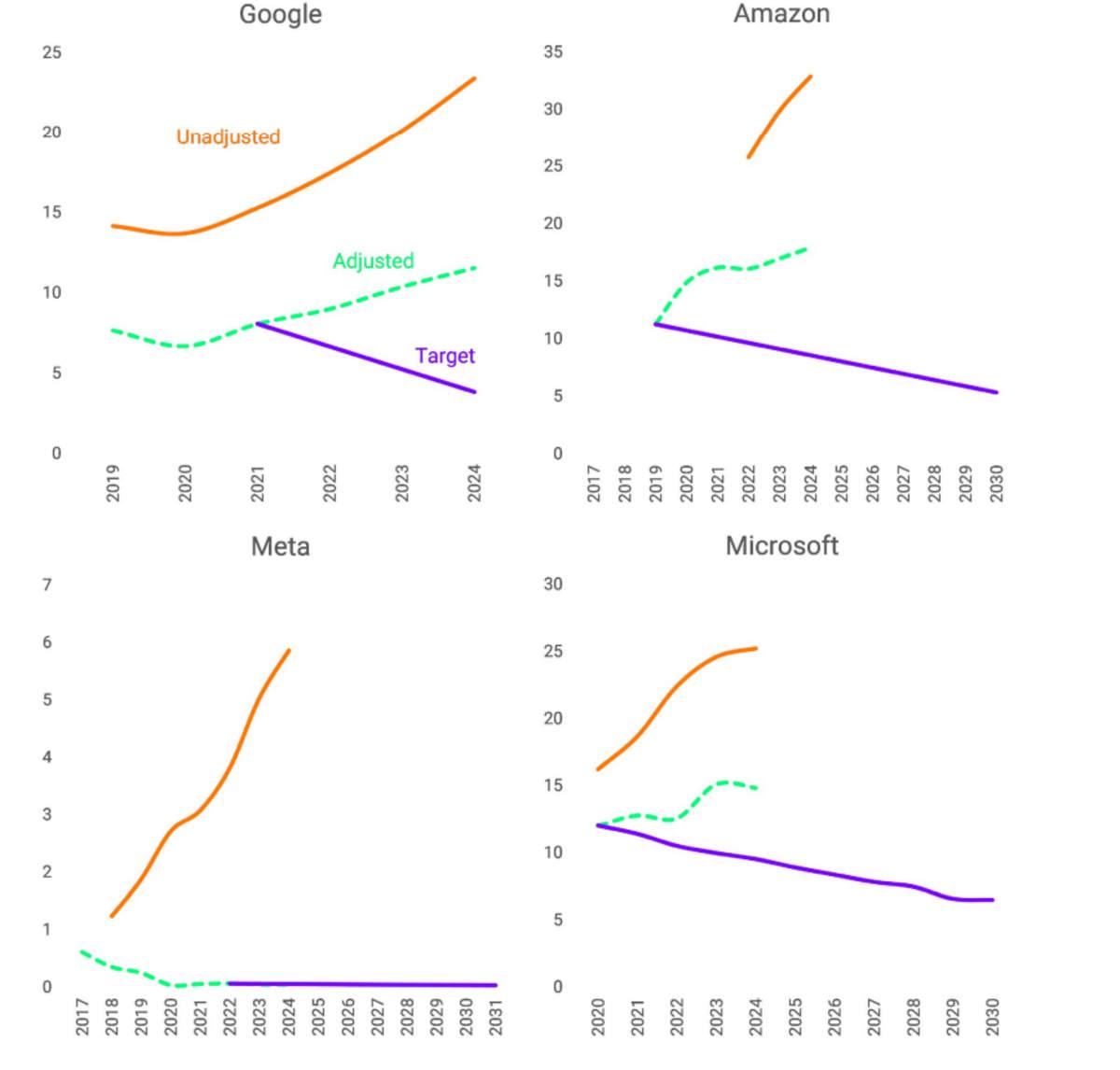
Emissions from Major Tech Giants
The report clearly reveals that tech giants’ statements carry very little authenticity. “People make assertions about the kind of societal impacts of AI and the effects on the energy system—those assertions often lack rigor,” shared Jon Koomey, an energy and technology researcher who was not involved in the report. “It's important not to take self-interested claims at face value. Some of those claims may be true, but you have to be very careful. I think there's a lot of people who make these statements without much support.” David Rolnick, an assistant professor of computer science at McGill University and the chair of Climate Change AI, further added that the issue with such claims centered around hypothetical scenarios and not on AI’s current state.
Ketan Joshi, an energy researcher who formulated the report, claims that transparency is the only way forward in this new world dominated by AI. “If [tech companies] are worried that people are overstating or exaggerating the climate impacts of generative AI, then there should be nothing stopping them from saying, ‘Well, OK, our energy growth this year was six terawatt-hours, and two of them were for generative AI,’” he said. “That's information that we push for more disclosure of in the report. I think that would ultimately be a very good thing for them.”