
Bizarre Climate Paradox Will Make Greenland’s Sea Levels Fall — Even as They Rise Everywhere Else
Published Jan. 27 2026, 4:34 a.m. ET

A hiker dwarfed by the fracture zone of a glacier on the Greenland Ice Sheet.
The ground beneath our feet may not be as static as it appears to be. The dramatic interactions happening between Earth’s springy crust and the hot, liquid materials churning in the fiery mantle keep the ground rising and falling, although this undulating dance is so subtle that it remains nearly invisible to the naked human eye. Scientists inspecting the Greenland Ice Sheet (GIS) got irrefutable evidence of this recently as they noticed a mysterious dynamic unfolding due to the occurrence of two parallel processes: melting ice and changing sea levels.
In a study published in Nature Communications, they reported that while Greenland’s ice sheet surrenders to the intensifying global warming, its retreat is loosening the burden on the icy ground, quietly causing the sea levels to plunge lower. Meanwhile, the rest of the world watches the sea levels rise and oceans swell up.
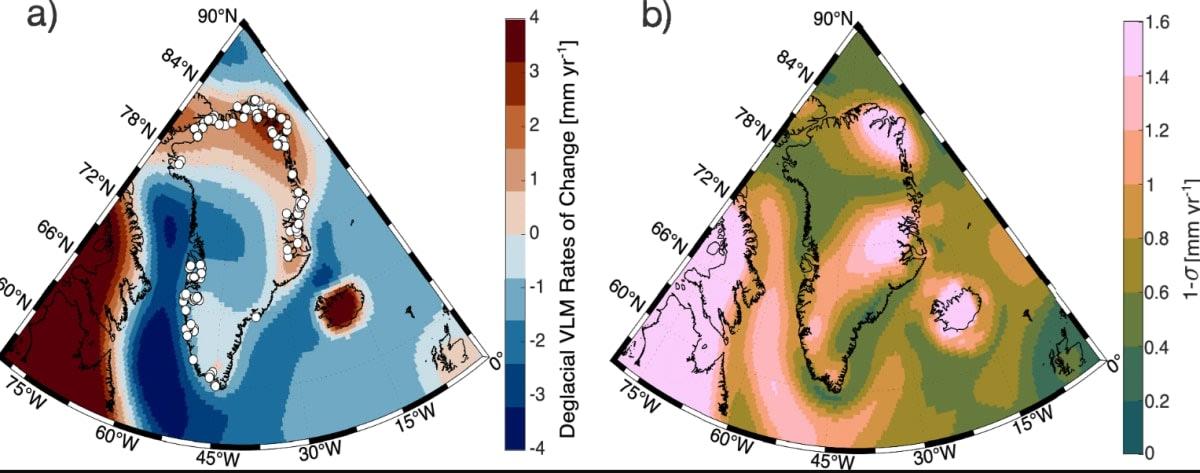
Present-day rates of vertical land motion (VLM) driven by deglacial mass change.
The story of rising and falling tides began with human-caused climate change. Rapid heating provoked a thermal expansion of ocean waters, and the ice in Greenland began to pull back and spill into warmer oceans. This mysterious interplay of tectonic, temperature, and other forces has provoked an uncanny behavior in the GIS. Stretching for roughly 660,000 square miles, roughly three times the size of Texas, GIS is the world’s second-largest body of ice. GIS is pampered by both the Atlantic and the Arctic waters and also lashed by the violent eddies of katabatic winds. As climate change forces extreme heat across the planet, Greenland is warming faster than Antarctica, losing a whopping 200 billion tons of ice each year.
One of the study authors, Surendra Adhikari, proposed that this recent ice-mass change is causing deformations and inconsistencies in Greenland’s grounds. This, in fact, has been happening since the Last Ice Age. When Adhikari and other researchers from Columbia Climate School made this observation, they predicted that the Greenland coastline would experience quite a different outcome than the rest of the world when it comes to shifting sea levels. “Sea level in Greenland is actually projected to fall,” stated lead author Lauren Lewright.
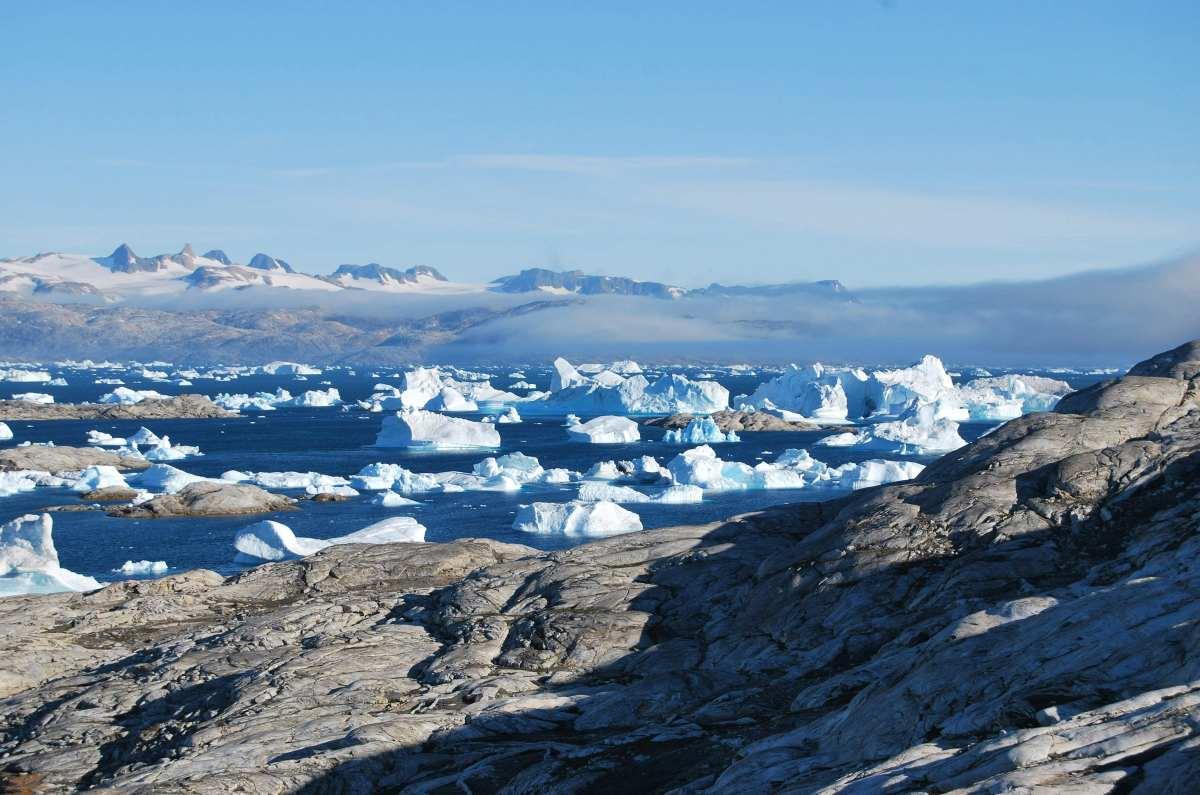
Melting icebergs in Greenland.
Study co-author and geophysicist Jacqueline Austermann likened the behavior to the decompression of a memory foam mattress after a person resting on it gets up. Much like a trainee relaxing his shoulders after a burdensome set of weight training, the crust beneath GIS will spring upwards once the burden of ice mass loosens and the meltwater sloshes away, a process scientists call glacial isostatic adjustment (GIA). With this rebound, the sea levels in Greenland will drop while the rest of the world will witness rising waters.
Another contributor to Greenland’s sinking seas is gravity. As long as the crust is suppressed under the enormous mass of the ice sheet, the ice sheet’s gravity keeps on exerting an attractive pull towards the seas. But as the ice sheet loses mass, the gravitational pull on the sea decreases. The sea falls while the land adjoining it jumps upwards.
Wooden map of Greenland.
Based on the analysis of GIA via dozens of satellite towers punctuated around the island, scientists projected the future of sea levels. By 2100, they said, the sea levels will rise nearly 3 feet in low-emission areas and will rise nearly 8.2 feet in high-emission areas. The impact will be very different in different parts of the world, as Austermann reflected.
Coastal communities, whose infrastructure, fishing industry, and shipping routes are all dependent on the seas, might be left high and dry. Fjords too will be dried up. Looking forward, these projections need to be meticulously scaled from a local or regional perspective. Only then can it be confirmed for sure.