
Beaches Are Shrinking Around the World. But Southern California’s Coast Is Surprisingly Growing.
Published Feb. 3 2026, 7:17 a.m. ET

Aerial view of the La Jolla Coastline in San Diego, Southern California.
Recent satellite imagery has revealed some crucial insights into the beaches of Southern California, as published in the journal Nature Communications. Climate change has led to a myriad of changes in beaches worldwide. A prominent one is the narrowing of beaches due to coastal erosion. Most California beaches have not escaped this wrath; however, some have surprisingly not only defied the trend but also gone in the opposite direction. Researchers believe this defiance has been possible due to human intervention. Another surprising finding from the investigation was that the rate of beach growth outpaced erosion in Southern California.
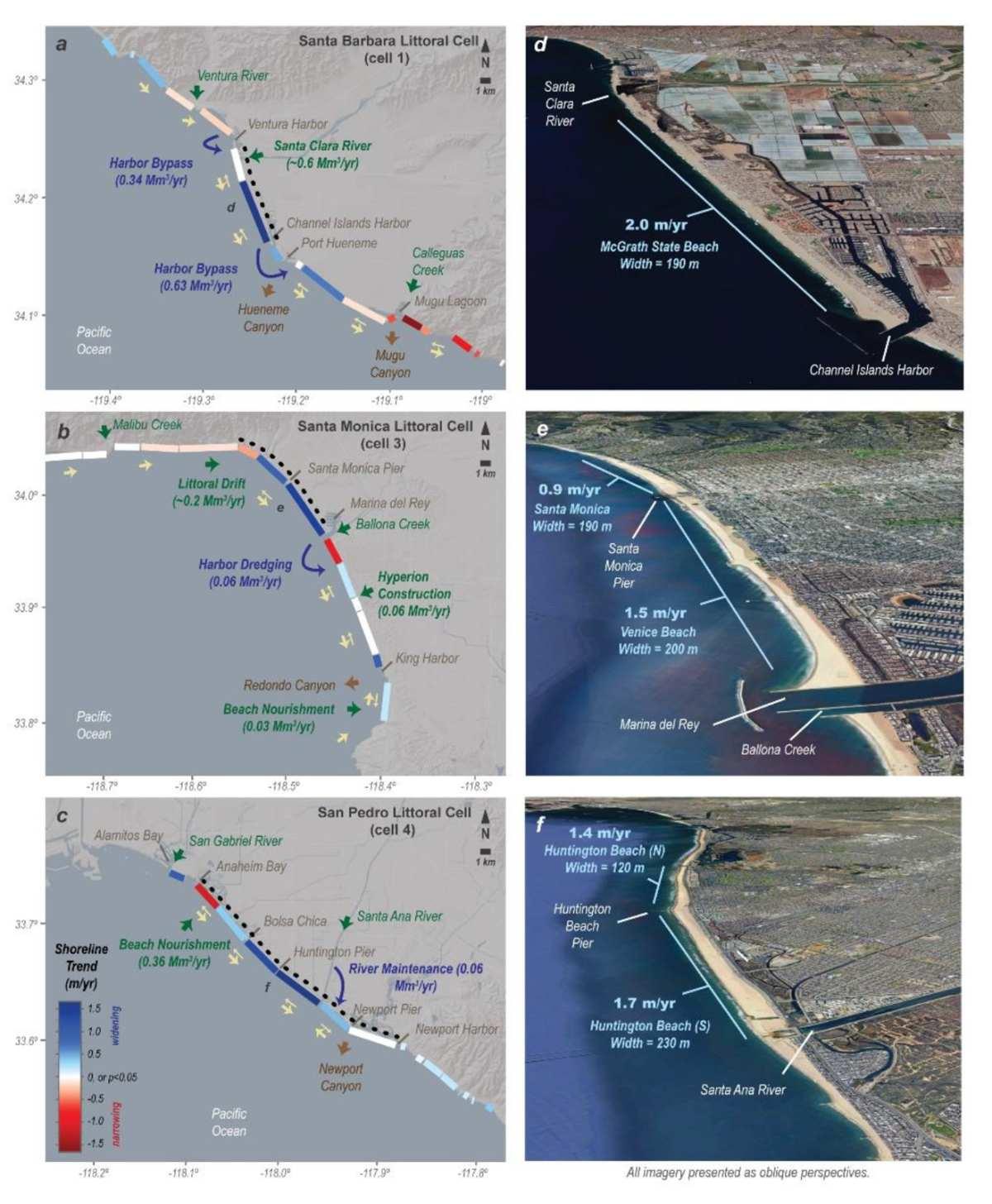
Site maps of three sections of the southern California coast with high rates of beach widening, from the study, Net widening of Southern California beaches.
Experts from USGS and the University of California, Irvine, did the investigations. For evaluation, researchers considered satellite data associated with 329 beach segments of California from 1984 to 2024. Results showcased that during this time period, there was an expansion of 0.77 square miles in the beach area along the southern California coast. Further examinations implied that the growth is a consequence of artificial beach nourishment and sediment trapping through man-made coastal entities. “Shoreline change in southern California is very patchy,” shared Jonathan Warrick, the study’s lead author. “What looks like regional stability or growth is actually driven by a small number of beaches that are expanding due to direct human actions.”
Man-made coastal structures are a double-edged sword. Breakwaters and jetties, along with localized beach nourishment projects, have been gathering sediment in the expanded Southern California beaches. These sediments, in turn, artificially inflated the shorelines. However, man-made structures are not just expanding the beaches. In many places, they are also facilitating erosion. The culprits behind erosions are coastal armoring, urban development, and dams. These structures interfere with the sediment supply from bluffs and rivers, which primarily make up the sand on the beaches. Taking away the sediments in these cases enables erosion.
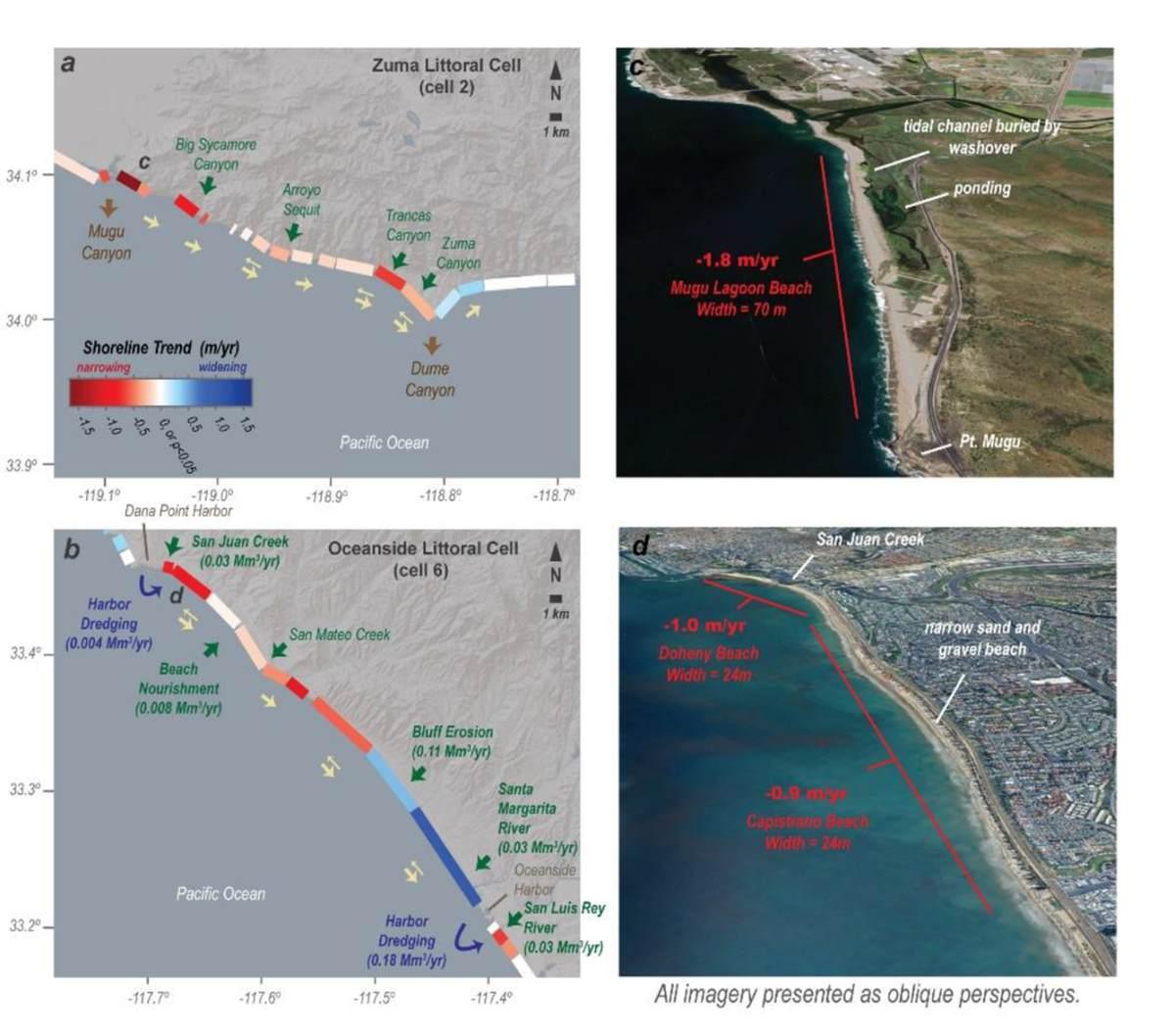
Site maps of two sections of the southern California coast with high rates of beach narrowing, from the study Net widening of Southern California beaches.
Researchers monitored shoreline positions across multiple beach segments and littoral cells across several years, using modern techniques. Results indicated that shoreline changes did not follow a set pattern in the region. Some exhibited a measurable beach expansion, while others remained the same size or deteriorated further. Carlsbad State Beach, Silver Strand State Beach, Border Field State Park, South Carlsbad State Beach, Torrey Pines State Beach, Cardiff State Beach, and Moonlight State Beach are some San Diego beaches that have shown enhancement, according to UC San Diego. Adam Young, a coastal geomorphologist at Scripps, shared that monitoring coastlines is necessary not only for their cultural importance but also for the protection against flooding.
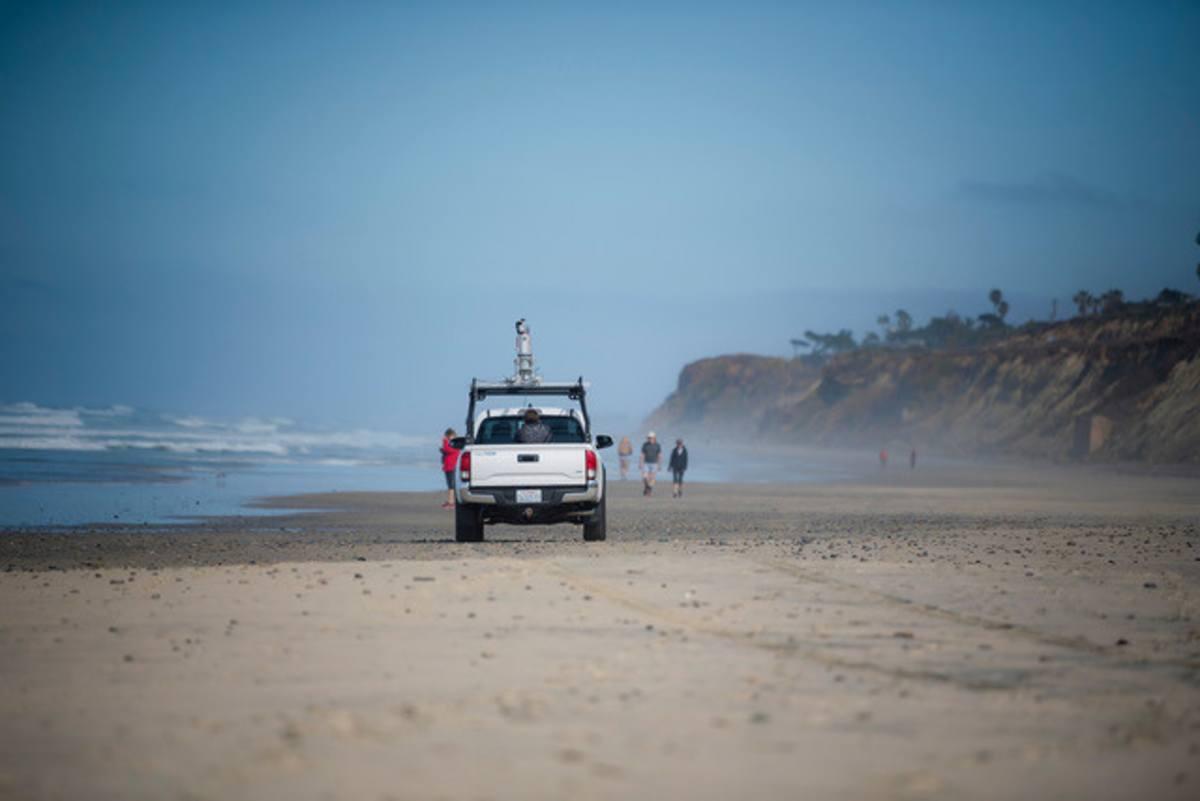
Scripps researchers conduct a beach survey using a LiDAR mounted atop a truck. The surveys measure changes in the coastline due to erosion or sand accumulation.
Scientists are happy with the recorded expansion in the 2025 San Diego County Beach Report, as it indicates that the beaches are recovering well during the El Niño recovery period. “The good news is that we are now officially in the beach recovery phase post-El Niño,” said William O’Reilly, an oceanographer at Scripps and the report’s lead author. “That said, the last recovery phase didn’t go too well, so we need to wait and see if beaches continue to recover or if it will be spoiled by increased atmospheric river activity or other extreme weather events.”
These findings are valuable as they can provide new measures for coastal sediment management. Researchers now understand which structures have expanded the beaches and can use them to achieve similar results in vulnerable areas. The insights also determine where sand redistribution is needed. The awareness would aid officials in protecting both the beaches and the coastal communities by directing pertinent resources towards the vulnerable sites.