
An Unassuming Bay Creature Is Quietly Protecting Young Blue Crabs From a Deadly Threat
Published Feb. 12 2026, 6:25 a.m. ET

Researchers deploy a floating cage containing one of the experimental groups of juvenile crabs and oysters.
In the salty, brackish waters of the Chesapeake Bay, a silent guardian sits amid swaying aquatic grasses, patrolling and protecting its marine life from diseases and dirtiness. Unlike most animals, this creature, the oyster, thrives in dirty waters. Every once in a while, the oyster opens its gaping shell, just enough to trap particles of floating algae, sediment powder, plastic chunks, and other junk. The material is pulled into the body, where a clump of hair-like structures acts like a sieve. Some important decisions are made, like whether the particle is delicious enough to be eaten or just waste to be expelled. The delicious particles go sloshing inside the food groove, where they get mixed with sticky mucous and are eventually digested in the gut. The rejected particles are expelled as sprays of powdery poop into the waters.
Oysters are infamous for this highly intelligent “dilution” or “filter feeding” ability that prevents the waters from turning into a mushy green soup. But recently, it has come to the scientists’ attention that oysters use this skill for more than just filtering the water. They quietly protect the blue crabs from a lethal parasite, as documented in Ecology.
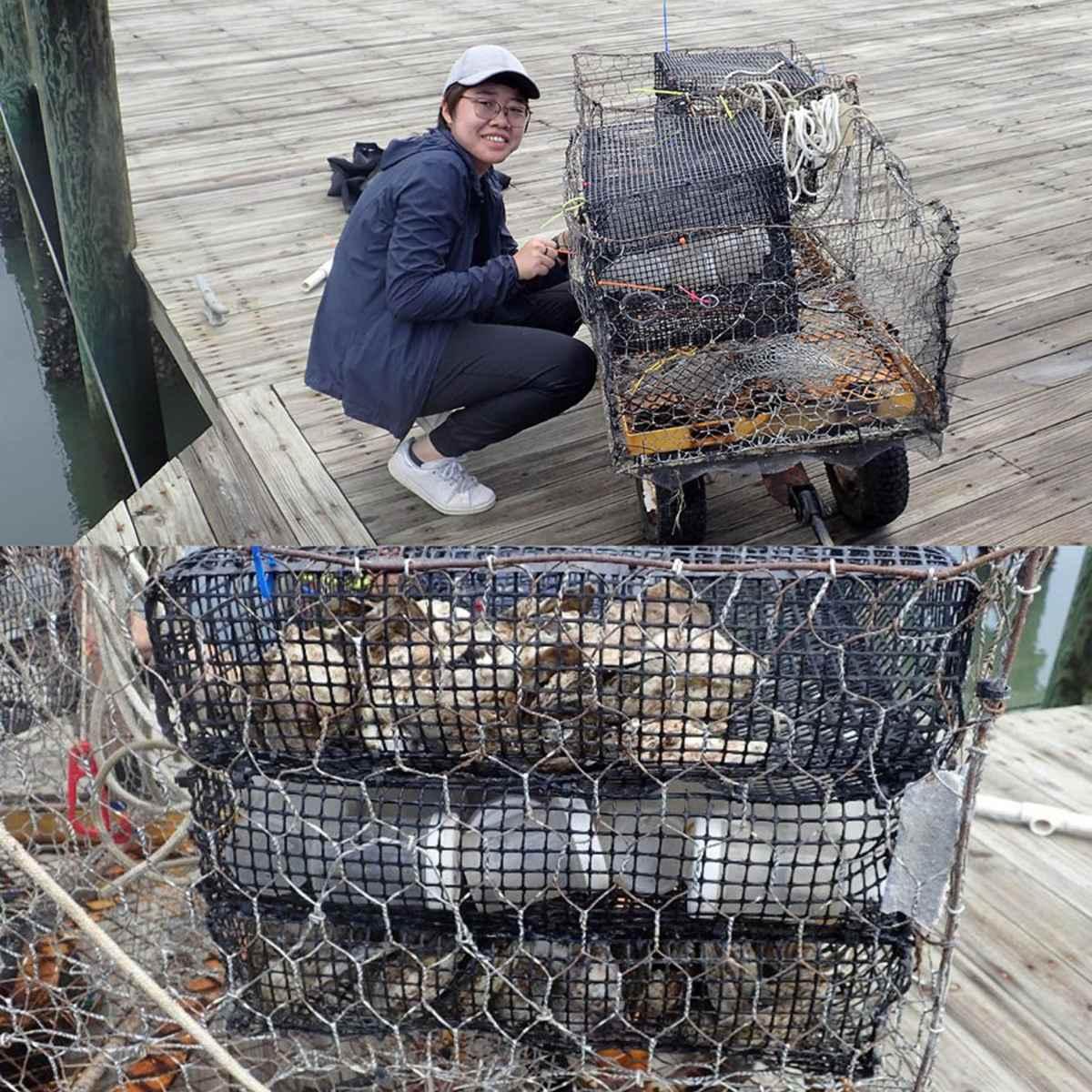
Lead author Xuqing Chen about to deploy crabs from the control group. Bottom: A close-up of a cage from the experimental group showing containers with juvenile crabs sandwiched between oysters.
On the sweltering summer days, researchers from William & Mary's Batten School of Coastal & Marine Sciences and Virginia Institute of Marine Science (VIMS) drove to the bay with metallic net cages and mesh containers that they used to trap several blue crabs and oysters. The location selected was the one where juvenile crabs were most exposed to the deadly disease-causing parasite Hematodinium perezi. Observations collected from these field experiments, coupled with laboratory experiments and mathematical modeling, revealed that it’s the oysters, not their shells, that are secretly protecting the population of blue crabs from the parasite.
To isolate the observations, the team divided the crabs into three different groups and placed them with three different types of oysters. In one container, the blue crabs were sandwiched between live oysters. In the second container, they sat beside empty oyster shells, and in the third, the crabs were unprotected. Observations indicated that juvenile crabs sitting alongside live oysters were one-third less likely to become infected by the parasite than the crabs deployed without oysters. Professor Jeff Shields, who worked on the research with the lead author, Xuqing Chen, reflected that the research offered an interesting piece fitting to the jigsaw puzzle of oysters’ filter-feeding mystery. For years, scientists were aware of their role in protecting the reefs through filtration, but to think that they can also protect other sea creatures is something new and exciting.
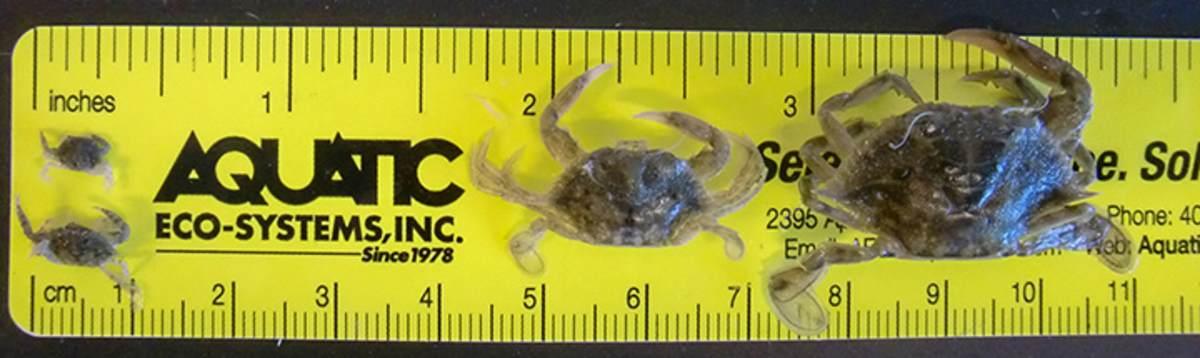
Researchers were also surprised to find that larger juvenile crabs were more susceptible to infection.
Researchers replicated the experiments in the controlled setting of the Batten School & VIMS’ Seawater Research Lab. They exposed oysters to dinospores, which are the H. perezi parasite in its free-swimming stage. They noticed that the oysters removed more than 60% of the parasite within an hour.
Many other remarkable insights emerged from the investigation. For instance, the large-sized crabs displayed more vulnerability towards this parasite than the small-sized crabs. Yet, the increased rate of mortality among crabs cannot be credited to oysters alone, said scientists. The filtration may, therefore, vary from season to season and from environment to environment. But this research could prove beneficial on a larger scale, guiding scientists on better strategies for fisheries management, suppression of disease transmission in warm coastal waters, and efficient management of overall aquatic ecosystems.