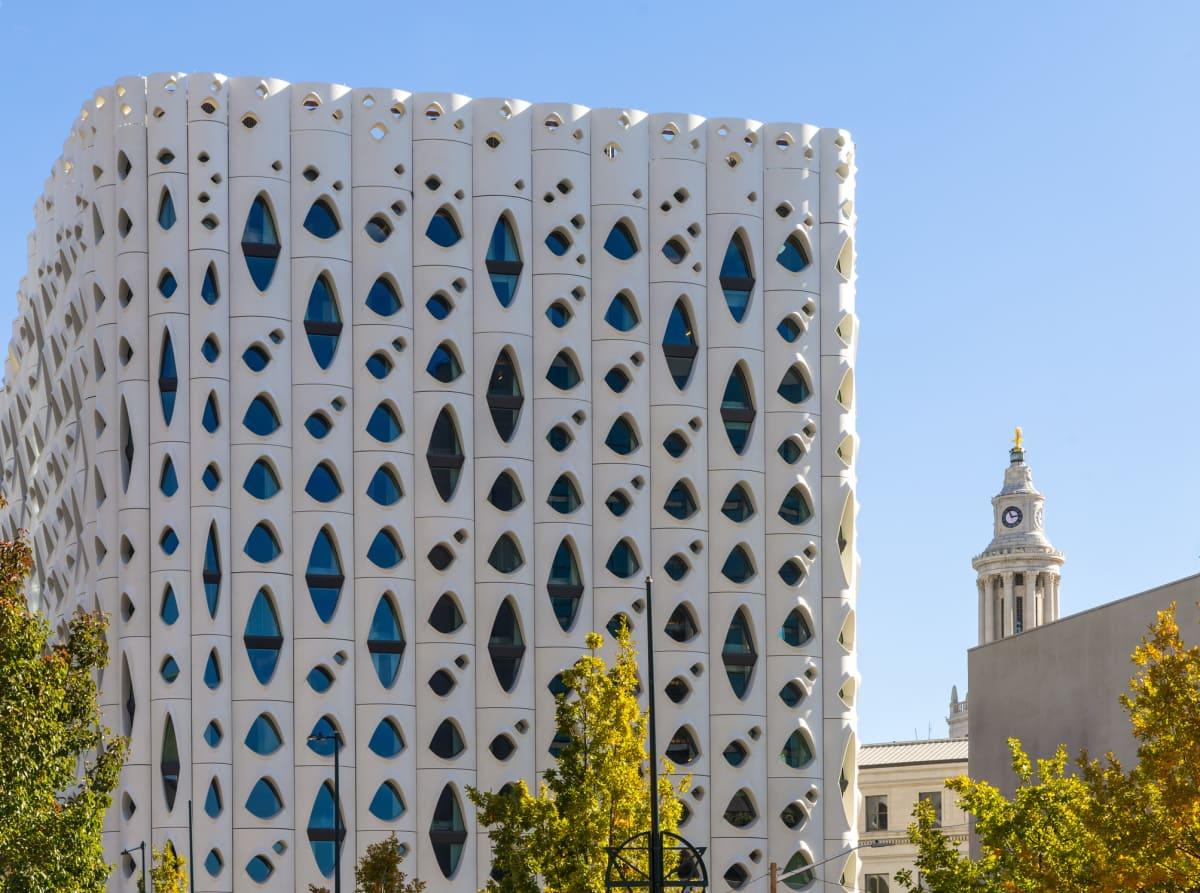
The name of the hotel, “Populus,” was inspired by Colorado’s widespread Aspen trees, also called “Populus tremuloides,” according to ArchPaper. The puckered, aspen eye-shaped windows are designed as reminders of the tree’s indistinguishable white trunks, along with the aroma of mountain wood, the holes of a flute which allows nature’s music to flow within its rooms, walls, terraces, and even elevators.
“We’re shaped by nature, its textures, its rhythms, its quiet sense of care. Inside, you’ll find beetle-kill pine at the front desk, reclaimed snow fencing overhead, cork in walls and furnishings, and The Reishi Tapestry—crafted from Fine Mycelium™, a revolutionary material grown from fungi,” the hotel writes on Instagram, highlighting its biophilic design.
It’s not just the comfortable rooms for stay, flowing cocktails, or cozy beds that the hotel is famous for. For every night a guest spends in their room, they plant a tree in downtown Denver. The drive is part of a bigger project that aims to sequester carbon footprint from the atmosphere, beginning with Colorado, of course.
ArchPaper describes that the project promises to plant over 70,000 new trees with sponsorships from Gunnison County, Colorado, and the United States Forest Service. Its 100 percent renewable electricity will be sourced from Colorado wind farms. “It’s a bold assertion given recent estimates suggest real estate accounts for nearly 40 percent of global greenhouse gas emissions,” Jon Buerge, the president of Urban Villages and the lead developer behind Populus, shared with CPR.
Developed by a renowned Chicago-based architecture firm, Studio Gang, the hotel is crafted from environmentally friendly materials like low-carbon concrete and upcycled snow fences embedded into the ceilings. This design is “a combination of environmental, experiential, and conceptual factors,” Studio Gang partner Juliane Wolf, per ArchPaper. Wolf recalled that initially, various materials were considered for the hotel, including cement and timber. But eventually, the durability and thermal regulation capability made concrete the winner.
A local company named Urban WoodWorks provided materials for furniture and interiors. Hallways were splattered with cork wraps, rooms were carpeted with biodegradable carpets, and the reception desk was chipped out from a salvaged tree. The goal was always minimizing carbon footprint, but the developers didn’t know that it’d turn out as white as the bees’ knees. What's more beautiful is the way in which the hotel staff transforms the whole food waste into compost.