
Stunning Northern Lights Display May Light Up the Sky This Week — See if Your State Is Included
Published Dec. 8 2025, 5:35 a.m. ET

Two people standing hand in hand beneath a dazzling display of Northern Lights
The stunning Northern Lights are predicted to grace the sky again before the year ends. The National Oceanic and Atmospheric Administration’s Space Weather Prediction Center has issued an alert about the upcoming phenomenon caused by a G3-rated geomagnetic storm, increasing the chances of auroras appearing. The storm prediction arrived after intense solar flares erupted from Earth-facing sunspots. "A full-halo coronal mass ejection (CME), associated with an M8.1 flare from Region 4299 at 20:39 UTC on 06 December, is expected to impact Earth early to midday on 09 December, potentially causing periods of G3 (Strong) geomagnetic storming," as per NOAA. Forbes has reported that 22 U.S. states have a chance of witnessing auroras in the sky. According to NOAA's aurora viewlines, the stunning display of auroras will be seen in northern U.S. states and Canada.
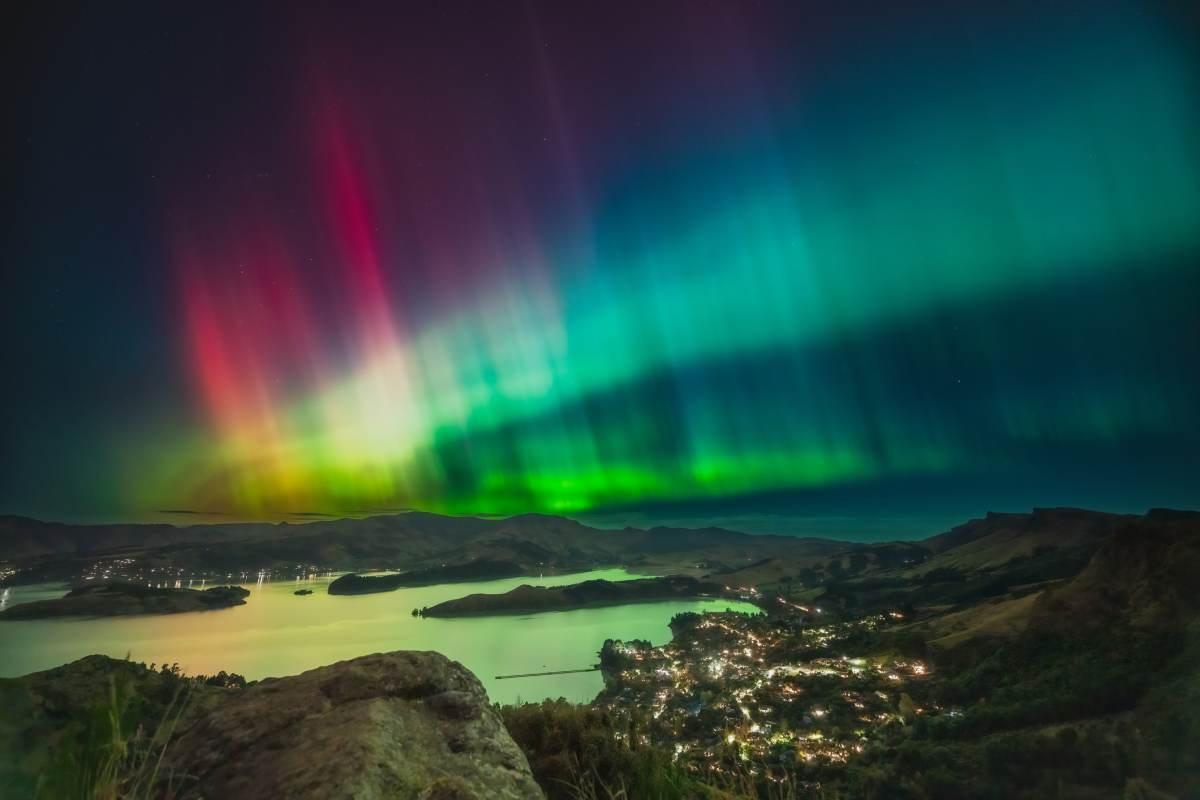
Dazzling curtains of aurora adorn the night skies
The U.S. states may include Alaska, Washington, Oregon, Idaho, Montana, Wyoming, North Dakota, South Dakota, Nebraska, Minnesota, Iowa, Wisconsin, Illinois, Michigan, Indiana, Ohio, Pennsylvania, New York, Massachusetts, Vermont, New Hampshire, and Maine. On December 7, the agency noted the presence of an M8.1 solar flare, "an eruption of energy." Although this solar flare is considered "more infrequent," it can act impulsively and last longer. According to the prediction, the auroras may appear from December 8 to December 10. However, on December 9, the geomagnetic storm will peak, increasing the chances of aurora visibility. The lights will appear the brightest just after sunset or before sunrise.
"The aurora does not need to be directly overhead but can be observed from as much as 1000 km [621 miles] away when the aurora is bright and if conditions are right," as per the agency. Aurora expert Vincent Ledvina took to Facebook to explain the reason behind the increasing number of geomagnetic storms this year. "We are currently in the decline of solar cycle 25, but still in an active phase of the Sun, so Earth-directed CMEs, big solar flares, and large geomagnetic storms are nothing to be surprised or concerned about," he wrote. However, the Northern Lights will be visible only if the impact of the geomagnetic storm lands as predicted. "If it misses, we get nothing," Ledvina added. "The CME needs to have enough strength to create a large geomagnetic storm." Lastly, the lights should be able to penetrate the clouds and be clear enough to be visible to people.
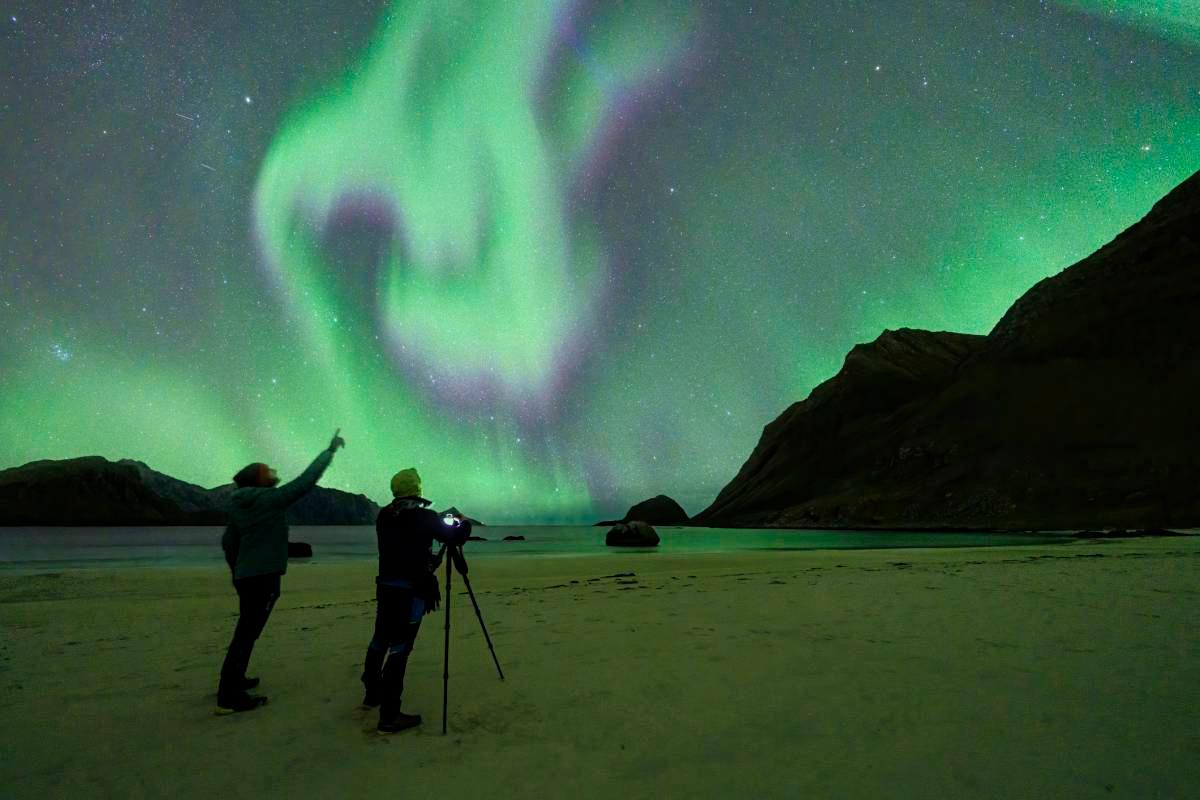
Two people looking at Northern Lights.
To get the best view of the auroras if they were to show up, locate a dark place using the Dark Sky Place Finder and a light pollution map. The darker and less polluted the sky, the clearer the lights will appear. If you seek to capture the moment, opt for a mirrorless or DSLR camera for the best results. But if you don't want to go to that extent, use your smartphone's camera with the 'Night Mode' or 'Pro Mode' turned on. Capture the auroras with the main lens of the camera instead of the ultra-wide to get sharper results. Keep the camera steady or use a tripod or rest it against something sturdy, like a wall or a car roof. Opt for the RAW format if available, so you can edit and enhance the beauty of the picture.