
Scientists Warn We’re About to Break Paris’ 1.5°C Climate Pledge and Enter a Point of No Return
Published Feb. 11 2026, 9:12 a.m. ET

Smoking chimneys.
1.5°C or 34.7°F for a long time has been considered to be the fatal boundary, beyond which the Earth would be unsalvageable. Scientists claim that despite the dangers associated with crossing this global warming limit being well-publicized, the measures taken to protect the climate have not provided satisfactory results, according to New Scientist. There are many reasons for this failure. One of them was that the very limit that should have cautioned the organization was seen as a mere target. Essentially, several parties justified their climate-exploitative actions with the reasoning that it was not crossing the set limit, even though it was bridging the gap.
Since setting the global warming limit, there has been a steady increase in carbon dioxide emissions due to human actions. At present, it stands at more than 41 gigatons every year. Fossil fuel industries continue to plan for expansions, while governments avoid strict green measures. All of these actions claim not to push the climate beyond the set mark. These claims were not untrue, as the warming levels have increased by just 1°C or 33.8°F since 2015.
These insights gave a perception that the planet is far from doom, when the reality was something different. The regular onslaught was pushing it to the point of no return. The limit was set at the Paris climate conference a decade ago, according to Yale Environment 360. Several nations agreed to limit the global average temperature increase 1.5°C or 34.7°F above pre-industrial levels.
The objective behind setting this limit was to prevent weather impacts and potential runaway warming from occurring, which can cause irreversible damage. The expectation was that the countries would create policies that would save the world from a disastrous fate. Unfortunately, nothing like this happened. Recent investigations suggest that the planet will soon breach the limit. “Climate policy has failed. The 2015 landmark Paris agreement is dead,” shared atmospheric chemist Robert Watson, a former chair of the U.N.’s arbiters of climate science, the Intergovernmental Panel on Climate Change (IPCC).
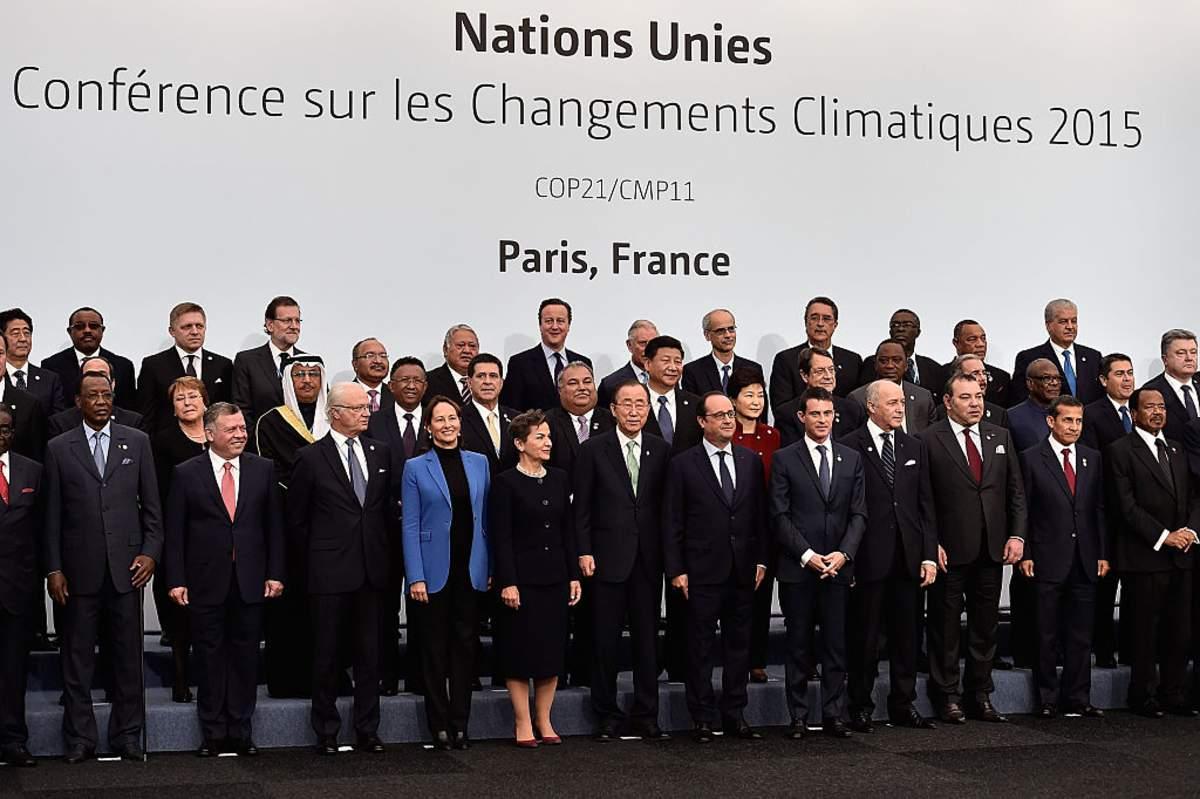
World leaders pose at the 21st session of Conference On Climate Change COP21 in Paris in 2015.
Researchers are anticipating the breaching. For the first time, the set limit was crossed at the conclusion of a three-year-period ending in 2025. They need to wait to confirm whether the global average breach has happened or not, as the reading is done over the course of 20 years. The long-term average is considered in this case, rather than the three-year-period, to avoid year-on-year aberrations. However, certain evaluations conducted last year, considering several current climate scenarios, suggest that the Paris limit has already been breached.
Once the global warming limit is crossed, the manner in which global climate change is unfolding will also reportedly transform. Climate change will no longer progress gradually; it will occur suddenly. If this assertion is true, even the previously stable planetary system will reach tipping points, limits from which there is no return. “We are rapidly approaching multiple Earth system tipping points that could transform our world with devastating consequences for people and nature,” said British global-systems researcher Tim Lenton, of the University of Exeter.
The terrifying predictions regarding the breaching of this global warming limit are slowly but surely coming true. The last three years have broken heat records one after the other. Heatstroke deaths have multiplied in the Middle East, India, and Africa. Unexpected wildfires have been spotted in the USA, along with tropical storms and extreme precipitation. In 2024, Bailing Li of NASA’s Goddard Space Flight Center claimed that global weather had dramatically intensified over the course of five years. International Chamber of Commerce shared that climate change has not only inflicted a loss of $2 trillion, but has also impacted the livelihoods of a fifth of the world’s population.
Some have suggested putting a new target of 1.7°C 35°F to stop the climate wrath, but experts claim that it would be of no use. It is because just like the previous limit, this one will also be treated as a target and used to lure parties into a false sense of security. Furthermore, with the current rate of emissions, no target is big enough. The need of the hour is for humans to take immediate and efficient steps to restrict the damage. One way to do it is by increasing the number of carbon sinks, where carbon emissions can go instead of the atmosphere. “We are seeing cracks in the resilience of the Earth’s systems,” concluded Johan Rockström, director of the Potsdam Institute for Climate Impact Research. “Nature has so far balanced our abuse. This is coming to an end.”