
Mysterious Plumes in Greenland Ice Sheets Puzzled Scientists for Years. They Finally Figured Out Why
Published Feb. 18 2026, 8:24 a.m. ET

Example plume features in northern Greenland.
Ice is supposed to be solid. This is what scientists believed when they thought about the Greenland Ice Sheet (GIS). The reality of GIS jolted the scientists of the University of Bergen into utter puzzlement. Underneath the grounds of Greenland, the thousand-year-old ice sheet is jiggling like the clappers, not much different from a pan of boiling noodles. Within the cold columns and walls of ice, plumes of steam are billowing sinisterly. Ever since scientists detected these swirling plumes of steam wafting within the ice sheet, they were left riddled until quite recently, when they actually cracked the mystery. Documenting the case of the mysterious plumes in The Cryosphere journal, the team revealed that they are symptoms of an enigmatic process whose origins lie in Earth’s fiery mantle.
Ice sheets are marked by radiostratigraphy, which refers to the stack of internal layers, like different layers of cream or frosting in a cake. Scientists usually employ ice-penetrating radars or radio-echo sounders to investigate these layers and extract information about the history, deformation, and accumulation of ice over time. GIS is the major contributor to global sea level rise and has always stirred the curiosity of scientists. When they examined its radiostratigraphy, they came across an unsuspecting, uneven ice gradient.
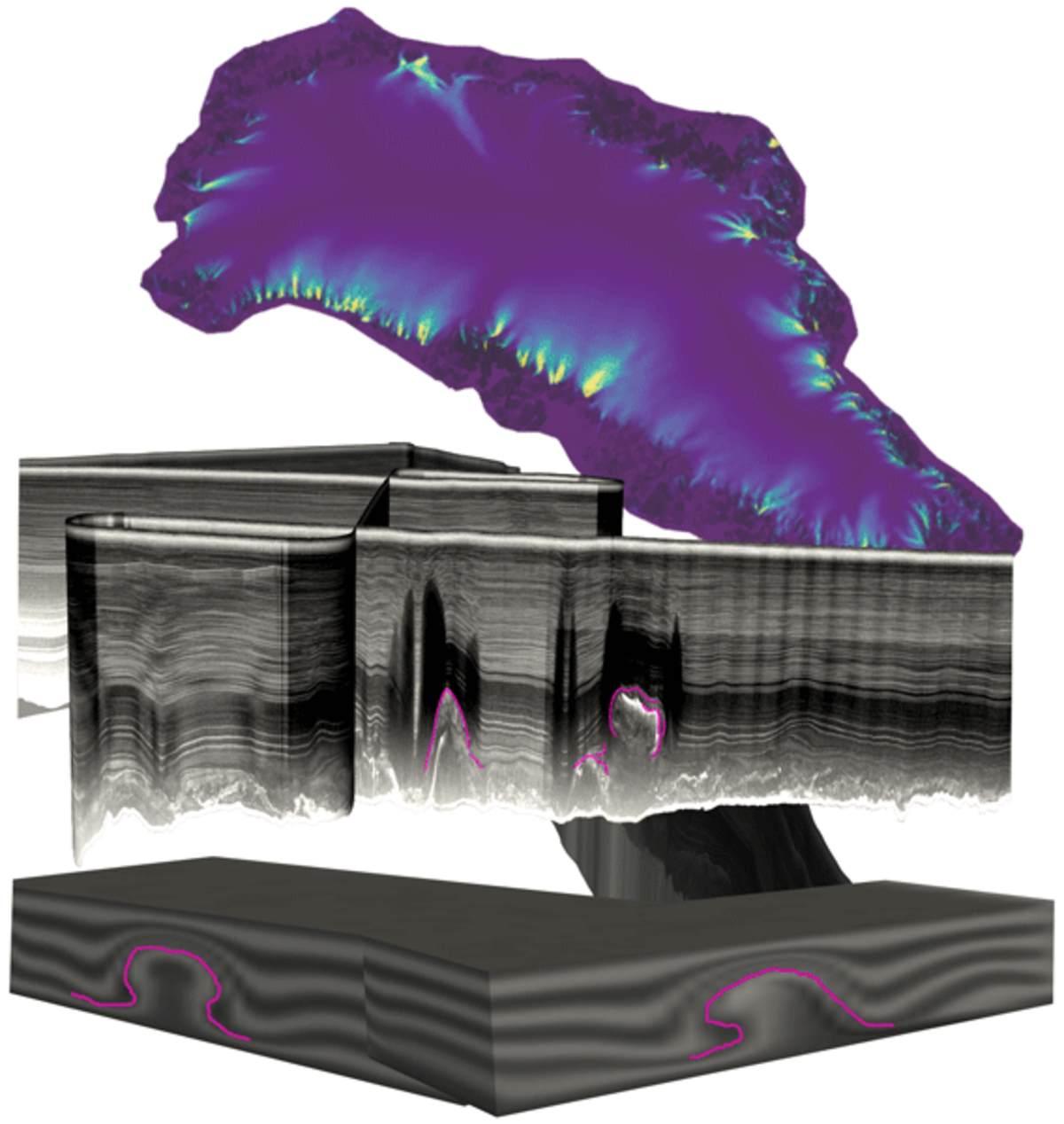
Graphical abstract of the internal dynamics of the Greenland Ice Sheet.
Andreas Born, a professor at the Bjerknes Centre for Climate Research and the Department of Earth Science at UiB, who has been studying ice in the Northern Hemisphere for more than 15 years, and his fellow researcher Robert Law reported that there is a “freak of nature” hiding deep beneath, which is provoking the formation of these steamy plumes. They conducted this study in collaboration with scientists from NASA Goddard Space Flight Center, the University of Oxford, and ETH Zurich. The editors, who reviewed it, selected it as a “highlight paper” given that they had solved a significant mystery in the world of science.
The mystery actually lies in a cryptic process that unfolds deep within the hot, churning mantle. It’s called “thermal convection.” As the name suggests, it has a lot to do with “heat,” precisely the heat that travels from the constantly simmering hotbed of the mantle. It’s like the ice becomes crammed between two giant hands, the cooler one softening and crushing it from the top and the hotter one pressing and contracting on it from the bottom. This thermal handclasp creates an unstable density gradient, forcing the melted material to flow upwards, generating churning convection pulses.
“As wild as it is fascinating,” Born exclaims, remarking on the intriguing process. To decipher the mystery, the team used the same mathematics climate scientists use to study the continental drifts. They also deployed ASPECT geodynamics models to test the hypothesis that this process was involved in the generation of mysterious plumes within the ice. Additionally, they acquired different angled views of the GIS from the southwest with surface elevations captured by the BedMachine.
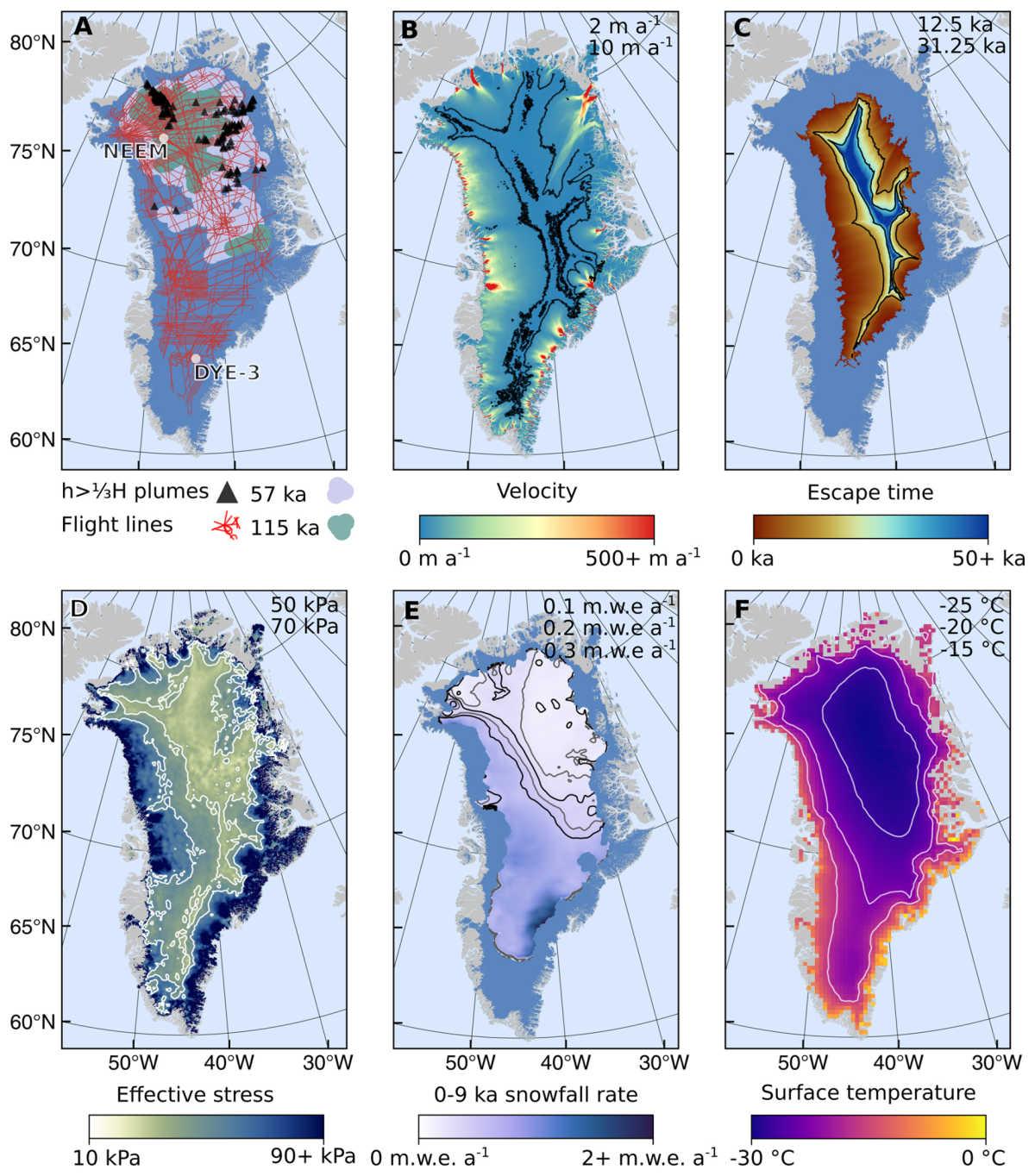
Relevant GrIS properties when considering convection. Contour values are given in the top right of each panel.
They took into account five main thresholds that the icy bedrock should satisfy to indicate the occurrence of thermal convection. Initial temperature, to begin with. Then came the perturbations in density, a certain ice thickness, snowpack, and appropriate viscosity. Analysis came hurtling as a shock, as it shattered all the expectations, assumptions, and intuitions previously held by scientists.
Data and observations revealed that deep ice might be softer than the Earth’s mantle, but this doesn’t imply that it will melt faster. It’s just physics at work, Law commented. Looking ahead, the discovery could pave the way to create models for ice melt and sea level rise in the future. The understanding of this contradictory physics, however, needs to be improved. To fully isolate the finding, more research is required. Law believes that the more we understand these deep ice behaviors, the better prepared we would be for how ice might respond in the future.