
Chinese Scientists Finally Create Rare Hexagonal Diamond, and It's Harder Than the Natural Kind
Published March 6 2026, 7:34 a.m. ET

Atomic structure of the bulk hexagonal diamond recovered from 20 GPa and 1,300°C. (Cover Image Source: Nature (2026))
The dream of a hexagonal diamond can soon become a reality. This claim has been backed by a study published in Nature. In the study, researchers from China shared how a “millimeter-sized, phase-pure hexagonal diamond” can be synthesized by uniquely compressing graphite at elevated temperatures. This is not the first time experts have come up with methods of creating hexagonal diamonds, but this one seems to be the strongest of the lot to date. The team confirmed that the resultant product's structure was hexagonal with minimal defects, using X-rays and atomic-scale microscopes. The diamond was around 0.04 inches in size and exhibited more sturdiness and resistance compared to typical cubic diamonds.
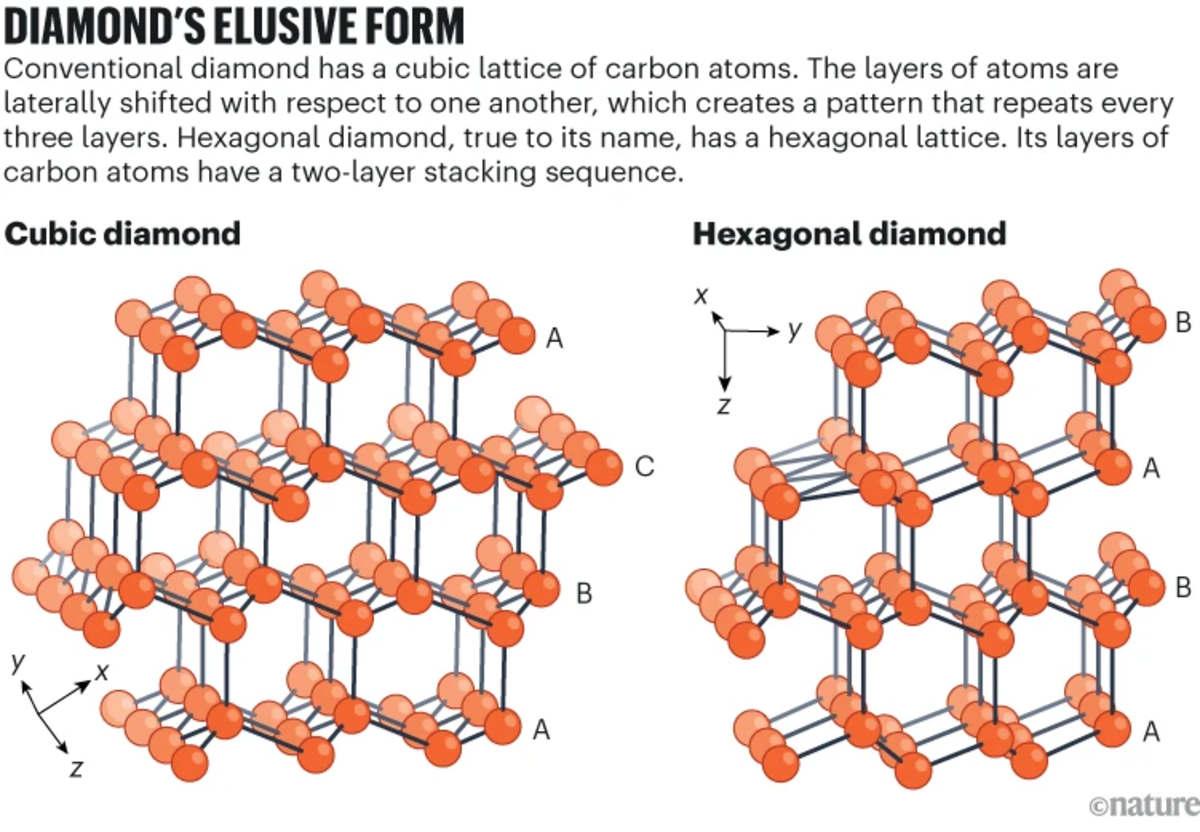
Structure of Hexagonal and Cubic Diamond
In 1962, experts predicted that diamond could be hexagonal and not just cubic, according to Nature. Later predictions said that hexagonal diamonds may display superior features, like being 50% harder than cubic diamonds. “There are hundreds of claims from people who believe they have seen it,” Oliver Tschauner, a crystallographer at the University of Nevada, Las Vegas, shared. Just five years after the concept of the hexagonal diamond was first predicted, geologists claimed to have found one in a meteorite in Arizona. This sample was named lonsdaleite. Around the same time, a lab claimed it had formulated a hexagonal diamond by heating and compressing graphite.
Further investigations suggest that lonsdaleite wasn't truly hexagonal diamonds; instead, they were cubic diamonds with defects. All the iterations of hexagonal diamonds that experts have managed to formulate over the years are deemed to be unstable or too small in size. “As a result, the existence of hexagonal diamonds remains controversial and elusive mostly because of the challenges in producing bulk pure-phase [diamonds], which have hindered further understanding of its intrinsic properties," the researchers wrote. Tschauner claims that the study provides the “first very accurate characterization of this elusive material.”
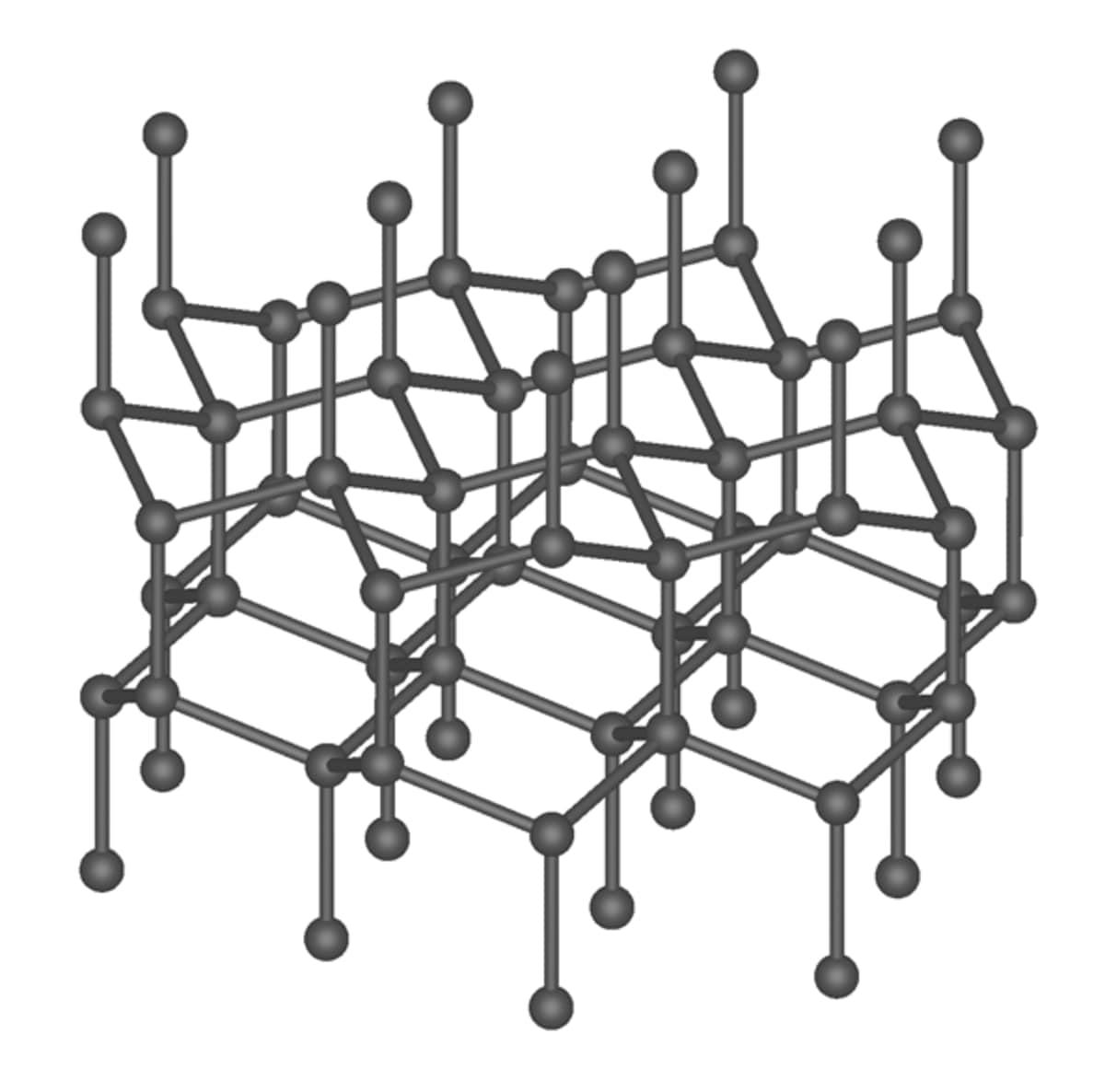
Structure of Lonsdaleite
Experts associated with the study placed a highly oriented graphite between two anvils made of tungsten carbide. The graphite was then squeezed with 20 gigapascals of pressure, at temperatures ranging between 1,300 and 1,900 °C. The force was focused on the graphite's c-axis, which implies that the pressure was directed at the top of the carbon layers and not at the sides. After the entire process, experts claimed that they had a pure hexagonal diamond in their hands.
The team confirmed their speculation with X-ray diffraction. In this technique, an item's structure is mapped based on the points X-ray bounces off an atom. Atomic-resolution electron microscopy was also applied to see the stacking patterns of carbon in the object. Both proved that the object was indeed a hexagonal diamond. The object's features were determined using the Vickers hardness test. The result indicated that it exhibited a hardness of around 114 gigapascals, which is slightly more than the 110 gigapascals exhibited by natural diamonds.
The insights support the existence of a hexagonal diamond, which can later be used in high-performance electronics and many other areas. "These findings resolve the long-standing controversy on the existence of HD as a discrete carbon phase and provide new insight into the graphite-to-diamond phase transition, paving the way for future research and practical use of HD in advanced technological applications," the researchers concluded.