
Alaska’s Forests Are Creeping Towards the North. And the Implications Are Paradoxical
Published Feb. 17 2026, 3:19 a.m. ET

Distribution of boreal across boreal ecoregions in 2020.
Draping about 6 million square miles across the Northern Hemisphere is a green, velvety belt flecked with acidic wetlands, Finnish tunturis, peat bogs, swampy lakes, deciduous patches of larch, conical spruce, and teardrop-shaped pines. In most places, the belt is carpeted by bright green mosses and hardy, low-lying shrubs that colonize the bare, rocky soils. Known as the “boreal forest” belt, this region has been keeping the Earth happy by replenishing its resources and pulling enormous stocks of carbon from the skies and hoarding it inside its green belly.
In recent years, however, the collective action of forces like global warming and snowmelt has pushed these forests beyond the threshold. Thanks to NASA, our satellites are constantly eyeing the forests for any signs of disorder or imbalance. In a study published in Biogeosciences, scientists documented how these trees are slowly crawling northward due to these factors. From the southernmost edge of the belt in Alaska, the forests are quietly creeping towards the Arctic soils, where conditions seem more favorable for their survival.
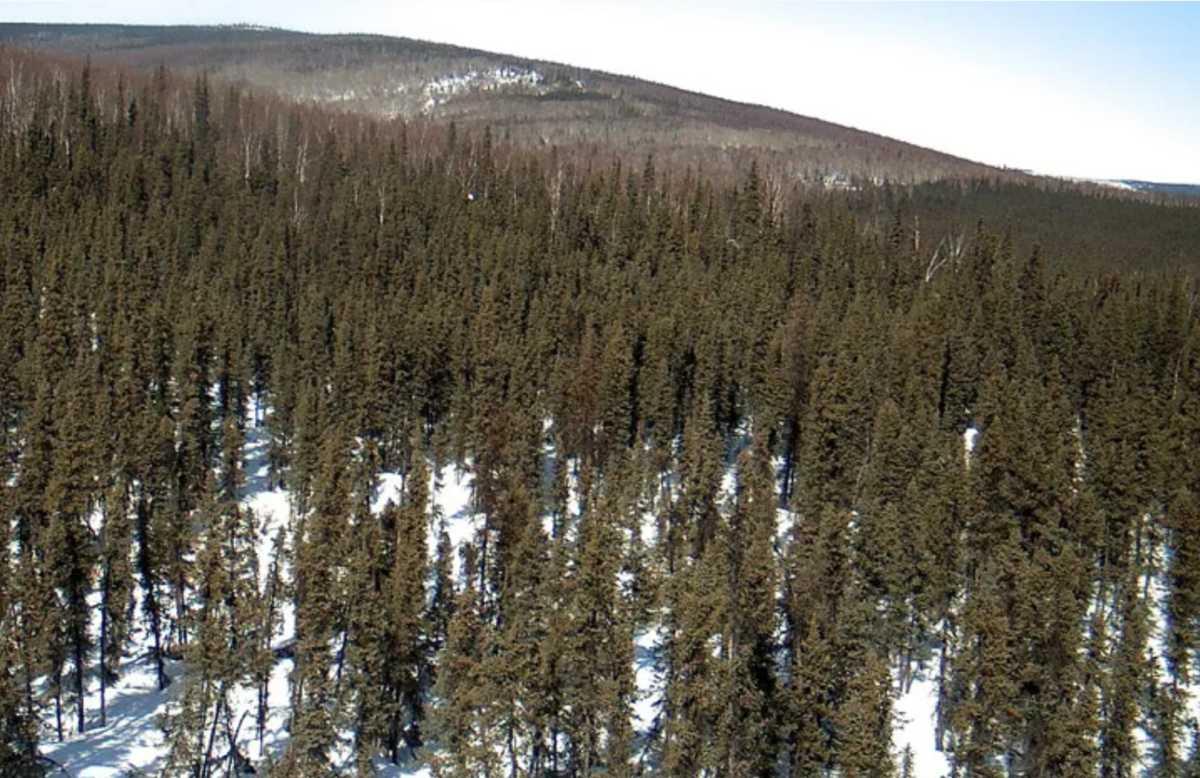
Alaska's boreal forest, carpeted with thick snow, and captured by NASA's Landsat satellites
If scientists were to estimate how much carbon trees in boreal forests could soak up, the figure would be somewhere between 1.1 and 5.9 gigatons. As they shared in a video, with the recent increase in extreme climates, retreating glaciers, soaring temperatures, and disrupted atmospheres, the forests have become a canary in the coal mine. The forests are lurching away from the southernmost edges in North America, leaving the soils dry and pestered by toxic algal blooms, while gravitating towards the cooler, icy soils of the Arctic. As they lug forward and stamp their foot into new, northward patches, scientists are spying on their every movement, using a combination of Landsat satellites, LiDAR, and terraPulse.
According to the International Boreal Forest Research Association and UNECE, the word “boreal” originates from Greek mythology, specifically from the word “Boreas,” the name of the god of the north winds, or a personification of cold north. Known by nicknames like “snow forests,” “taiga,” and “tayga,” the bracelet of boreal forests is the world’s largest patch of land biome, punctuated with coniferous trees like pine, spruce, alder, fir, poplar, birch, and larch. Nearly 30% of the global forest area is covered by these forests, spanning eight countries, with the starting point in Alaska.
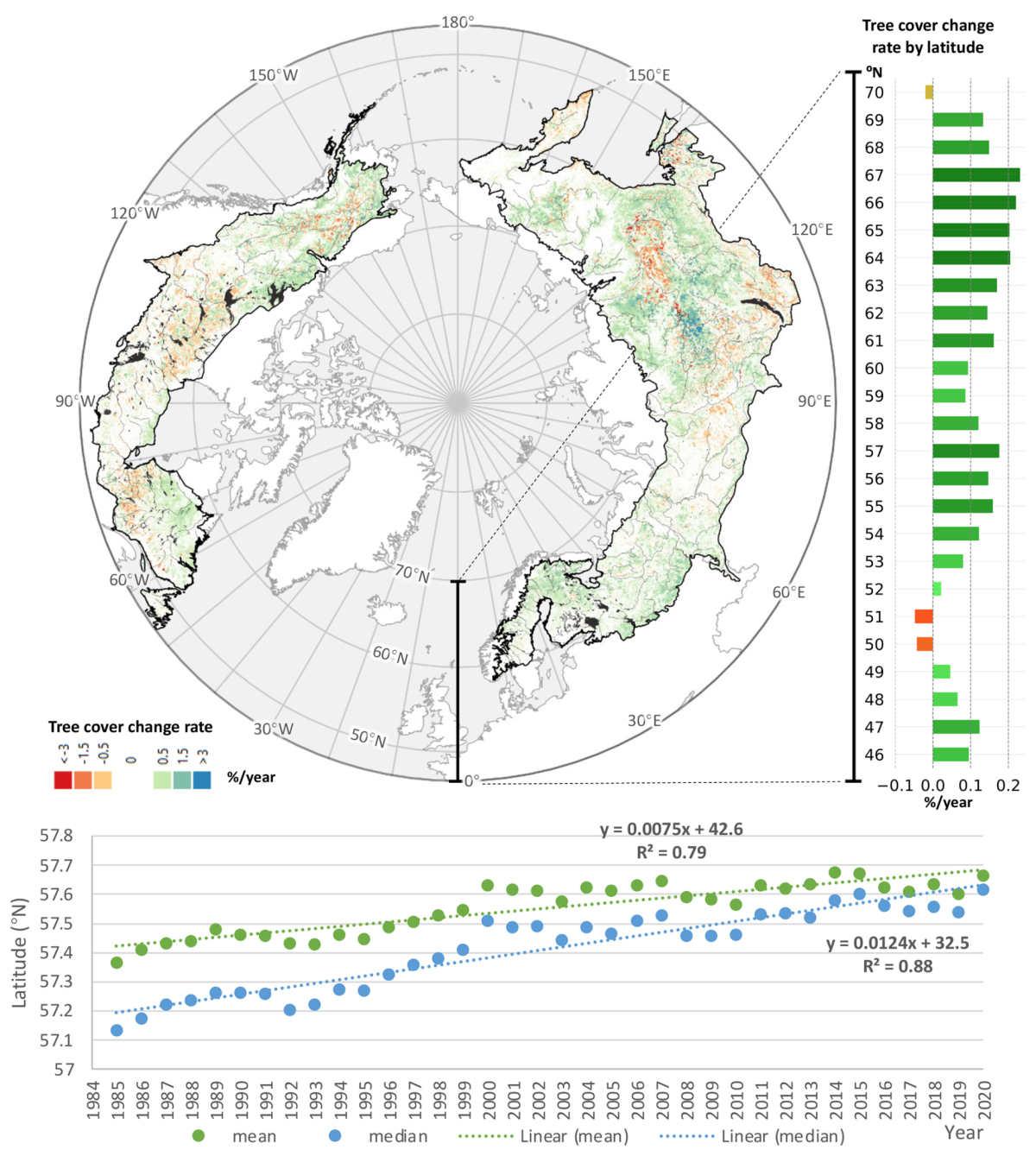
Spatial and temporal distribution of boreal tree cover change from 1985 to 2020.
The young boreal trees prefer environments where temperatures are not too high, where they can comfortably sip the water from melting snow and grow in height and develop lush canopies. The recent decades have proved to be harsh for them. Long spells of winter, short intense summers, recurring disturbances like wildfires, and other events like these have taken a toll on them. Add to it the notorious insects like bark beetles, which don’t shy away from assaulting the trees to construct shelter for their babies and slurp on some delicious sweet sap. The beetles dig holes in the trees, but humans simply chop them down for everything from medicines to spiritual rituals and, blatantly, just for leisure. More than 33% of the lumber and 25% of the paper are ripped from the dying barks of the boreal trees.
Coupled with recurring natural perturbances and wicked bugs, this unrestrained human activity also hinders the forest from conducting a vital function that is also one of its major contributions to the planet. For years, boreal forests have remained a large reservoir storing the carbon stock and preventing greenhouse emissions. But now, scientists are skeptical as to how long the forests will be able to do it. All these speculations materialized when NASA scientists analyzed satellite images for the period between 1985 and 2020. They made a detailed map of tree cover at a resolution of 100 feet to track changes over that period of time. They concluded that the boreal forests grew by 12% and also shifted northward by 0.29 degrees of mean latitude.