
Africa’s Most Aggressive Volcano Has a Lava Lake That Glows Bright Red at Night
Published Oct. 11 2025, 8:45 a.m. ET

People near a volcano with its surreal glowing lava lake
Amble along the treacherously steep trails of Mount Nyiragongo looming over the city of Goma near the border of Rwanda. You’ll be welcomed with the familiar stench of sulphuric acid you might have smelled in your school’s chemistry lab. Throughout the day, the mountain remains crowned in thick plumes of acidic mist and billowing white smoke that hovers above the trees. Punctured in the middle of the mountain is a massive crater deep enough to swallow the Empire State Building, as also documented by BBC Earth Science.
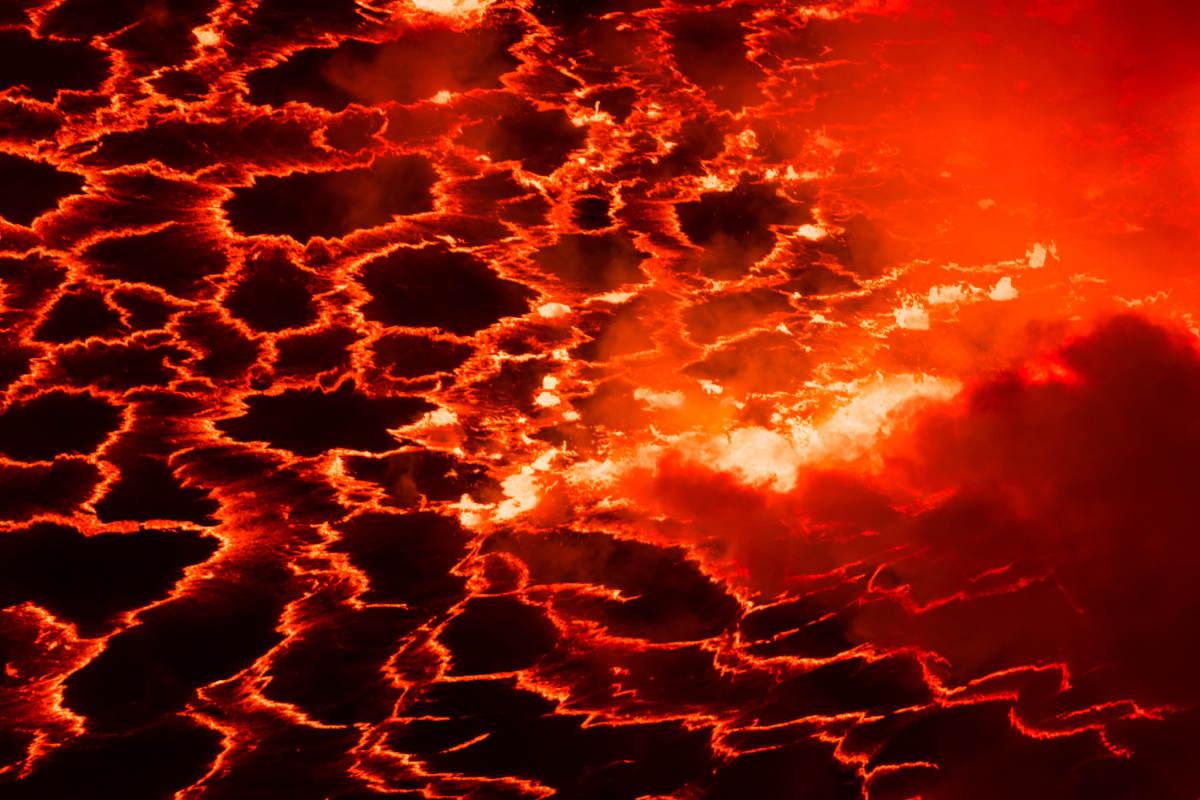
Mount Nyiragongo volcano in Africa with its surreal glowing lava lake
The smoky drama continues throughout the day. But when the night falls, this crater reveals its true colors. When the sky becomes enshrouded in darkness, cracks open up in the flanks of the volcano and an incandescent deluge of red-orange lights up the mountain. Located roughly 6 miles from Mount Nyamuragira, Mount Nyiragongo cradles the “world’s largest lava lake,” situated in the Democratic Republic of Congo (DRC). Carrying the reputation of being “Africa’s most dangerous volcano,” Nyiragongo holds a tapestry of fissures and crevices that are constantly fed by the pressures simmering within the fiery magma churning within the cauldron of Earth’s mantle.
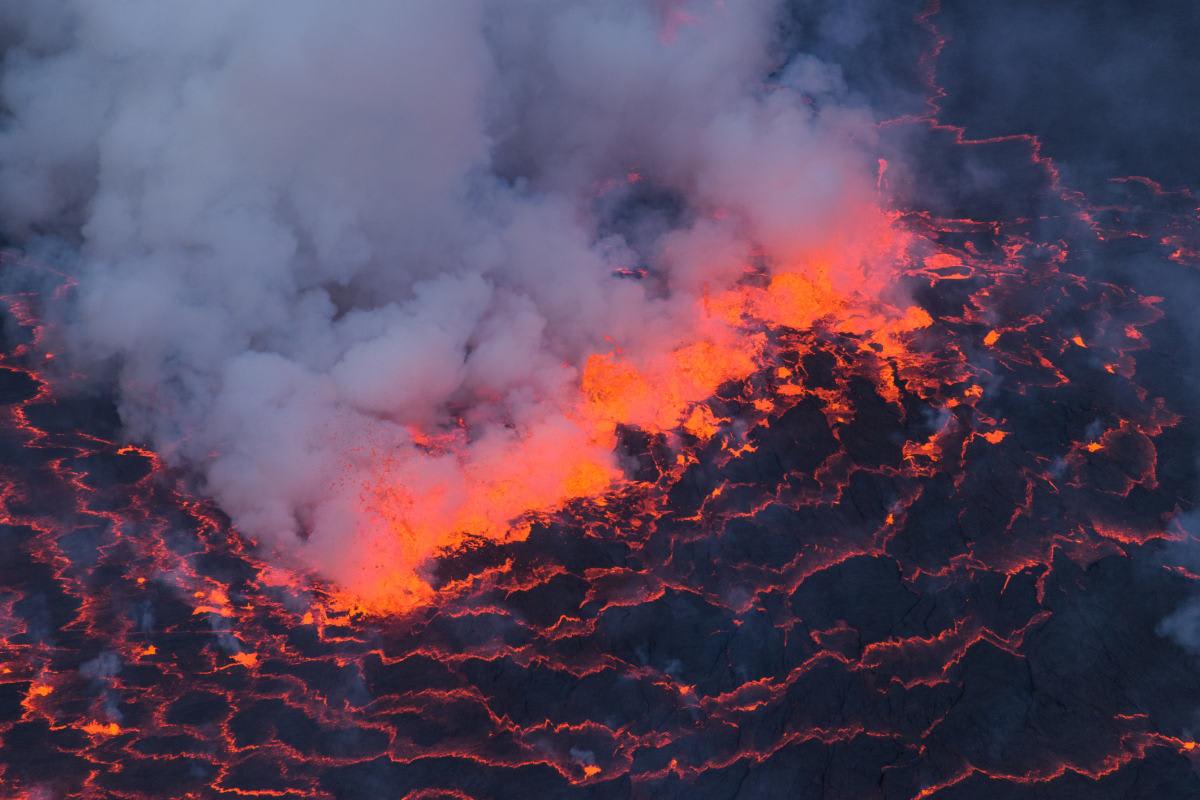
Mount Nyiragongo volcano in Africa with its surreal glowing lava lake
When the heat becomes too intense, the magma rises upwards. This rapid upwelling of heat forces the lava to burst through these cracks and spill downwards, dribbling along the slopes of the coal-like volcanic rocks. At night, this lava flows down to collect in what is known as a “glowing lake.” When volcano expert Chris Horsley visited the volcano, he noticed a string of fissures carved into the mountain, as seen in a documentary by Naked Science. These fissures, he reflected, appeared to be calm on the surface, but their very existence hinted at a violent lava flow exploding within. The unfolding of this episode is usually triggered by “Mazuku,” a Swahili word for “evil winds.”
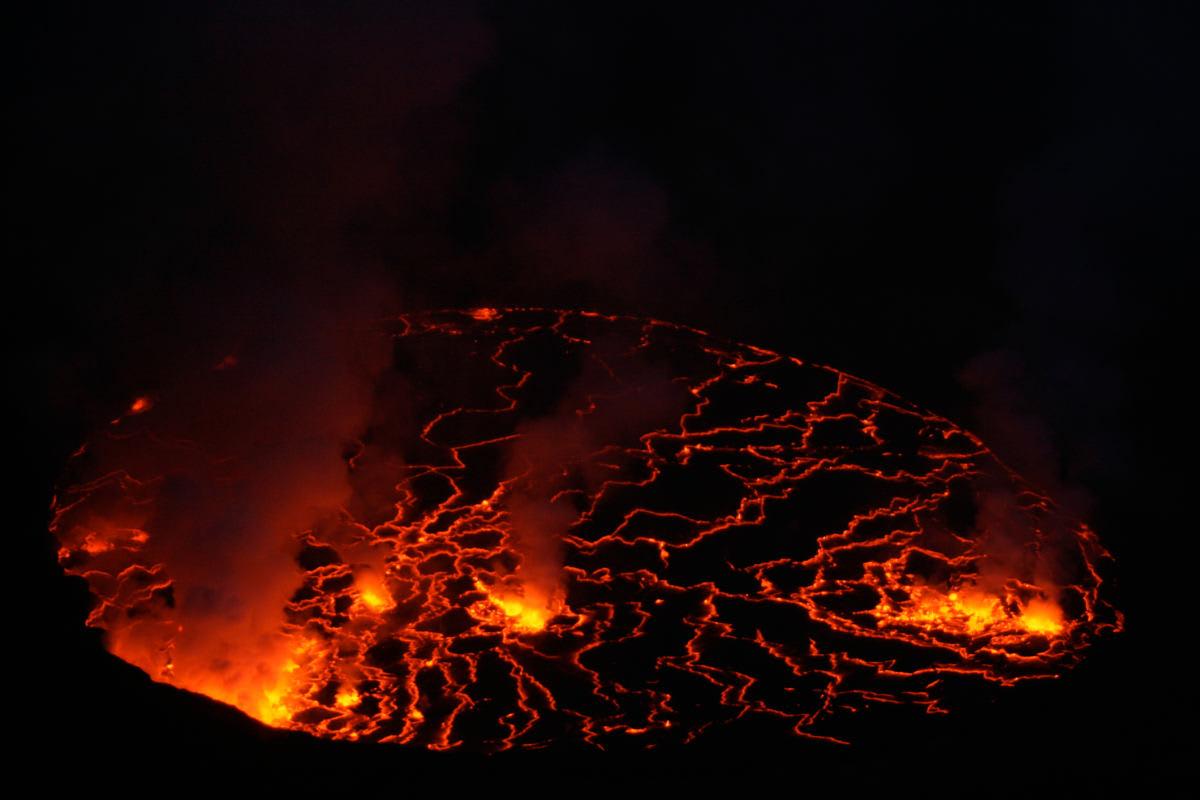
Mount Nyiragongo volcano in Africa with its surreal glowing lava lake
In this case, these “evil winds” carry enormous pockets of toxic carbon dioxide gas that swirl over the volcano, fanning its hot plumes. When monsoons arrive, the cool droplets hitting the rock intensify the process even more. Another documentary, shared by BBC Earth Science, recorded scientist Dario Tedesco visiting the “lava lake” to collect a sample. Back in the laboratory, geologist Tom Darrah deconstructed these samples for investigation. After heating and analyzing the sample, Darrah revealed that it was, in fact, a fascinating “time capsule of Earth’s history.” Holding a crystalline black volcanic rock in his hands, he said the bubbles trapped inside it revealed traces of chemicals like strontium and neodymium, elements which are only found in one other place – ancient asteroids.
Watch the video here.
This offered a clue that indicated that the rocks likely formed around 4 billion years ago, when Earth was born out of the Big Bang explosion. On June 30, 2014, NASA’s Landsat 8 satellite captured a false-color image of Mount Nyiragongo, which displayed a distant view of the lava lake glowing red. The image, also shared by NASA Earth Observatory, shows a stretch of green vegetation with a hot-looking white plume rising from the volcano and a trail of lava flows pouring into a neon red crater, likely to be the lava lake.