
A Rare Southern Aurora Reached Brazil, and a Photographer Managed to Capture Its Purple Glow
Published Feb. 5 2026, 9:12 a.m. ET

Astrophotographer captured a rare aurora in southern Brazil skies.
Typically, auroras materialize in the higher latitude skies near Earth’s north and south magnetic poles. Fiery squalls of charged photons crash into the planet and breach its magnetic boundary, leaping into the skies in dazzling curtains of colored lights. On January 19, however, Earth encountered an exceptionally intense storm, not the usual solar flare or coronal mass ejection, but a super-violent solar radiation storm that triggered the display of a rare aurora in the Southern Hemisphere, as far as southern Brazil.
At night on the same day, astrophotographer Egon Filter (@egonfilter) was watching the southern skies when he noticed a purple glow appear. For a few minutes, bands of this purplish-pink light embellished the skies above him. Without wasting a moment, he pulled out his camera and snapped a picture.

Astrophotographer Egon Filter
"It was a fantastic, truly thrilling feeling to check the camera and see that I had captured the image," Filter shared with Space.com, adding, "I took a few more pictures and, after a few minutes, it had already disappeared." He said that for an aurora to be visible at low latitudes, a very violent and exceptional solar storm is necessary, which indeed was the case. Followed by a powerful and fast Coronal Mass Ejection (CME) on January 18, the geomagnetic storm magnified to a G4 intensity, eventually setting off a kaleidoscope of auroras in the skies, as NOAA's Space Weather Prediction Center also said.
Filter captured the aurora from Cambará do Sul in Brazil’s Rio Grande do Sul state. The photo he shared on his Instagram shows him standing beside a woman beneath the purple-blue skies on a patch of grass. The skies seem to be drenched in curvy splashes of dark blue and purple dotted with the radiant glow of zillions of diamond-like stars. "We were looking south on Jan. 19th when this strange purple band appeared. At the time, the planetary K-index was 7.6," he said.
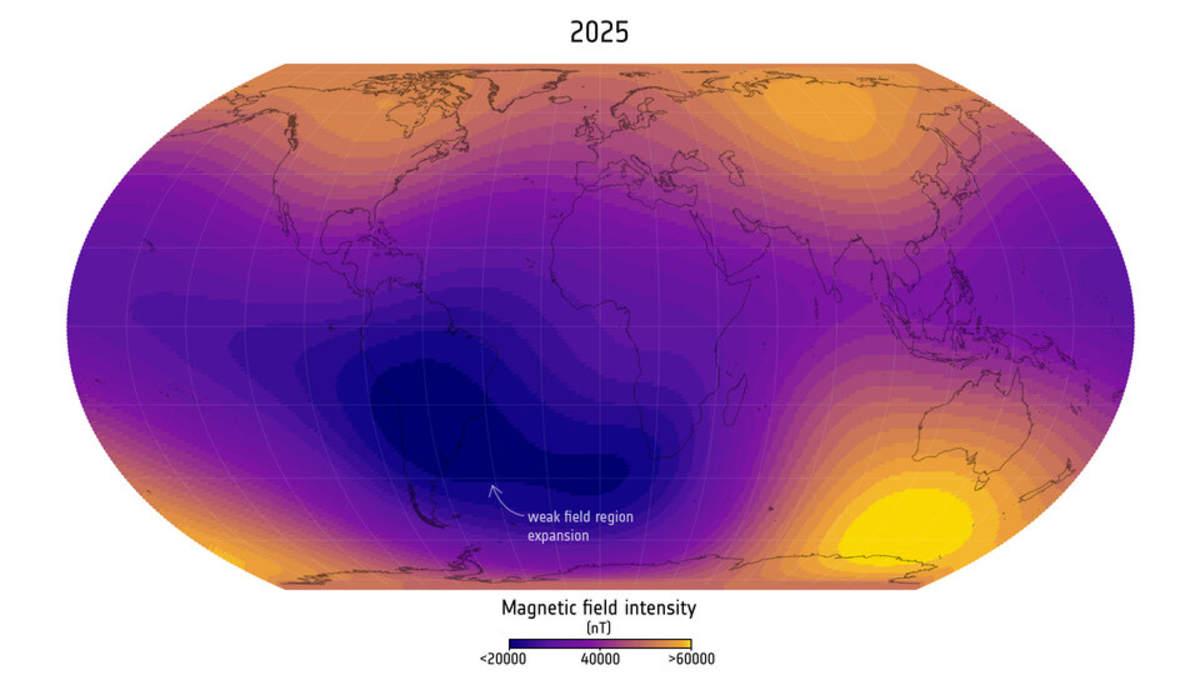
South Atlantic Anomaly in 2025 (Image Source: ESA (Data source: Finlay, C.C. et al., 2025))
The aurora actually formed over the South Atlantic Anomaly (SAA). The SAA is a weaker spot in the planet’s protective magnetic shield, thinner than elsewhere, so it allows energetic particles from the inner radiation belt to dip unusually close to Earth. Not that its vulnerable fabric enables any solar storm to penetrate the Earth’s defenses, but auroras certainly are weaker near this region. This makes the recent sighting in Brazil surprising and rare.
Rare, but it wasn’t unexpected, solar physicist Tamitha Skov believes. "These observations are consistent with the expected behavior from the Sun-Earth system, right now," she told Space.com. "Many of us have been predicting we would see this kind of aurora for years now. In fact, some of us have actively asked aurora field reporters to be on the lookout for it." she added. Skov reflected that recent solar activity is closer to what scientists consider normal when averaged over the past 24 solar cycles. The Sun, she said, is currently returning to a more “active posture."