
'World's Refrigerator' in Trouble? 2025 Arctic Report Card Warns of Intense Warming, Rapid Ice Loss
Published Dec. 17 2025, 7:45 a.m. ET

Vulnerable polar bear stands on an ice chunk amidst melting sea ice and rising sea levels
Waters are becoming warmer and saltier. Seas are rising. Glaciers are collapsing. Icy slopes are turning greener, but rivers are rusting and turning orange. The last 10 years were the 10 warmest years on record... These are some of the remarks that the “world’s refrigerator” has received in its 2025 annual report card. The report card was shared by NOAA. And ever since it has been made public, scientists have been contemplating the fate of our planet. As the “world’s refrigerator,” a.k.a. Arctic, falls under the weakening clasp of the climate crisis, the rest of the planet might have to suffer painful consequences.
To create the report card, scientists recorded the status of the atmosphere, oceans, cryosphere, and tundra. The report card mentions that the Arctic is heating four times faster than the rest of the planet. From October 2024 to September 2025, for instance, the temperature across the Arctic was the hottest in 125 years according to the record-keeping books. Arctic’s thickest ice receded by more than 95% since the 1980s due to rapid warming and rain. “This year was the warmest on record and had the most precipitation on record – to see both of those things happen in one year is remarkable,” scientist and editor of the report card, Matthew Langdon Druckenmiller, told The Guardian, adding, “This year has really underscored what is to come.”
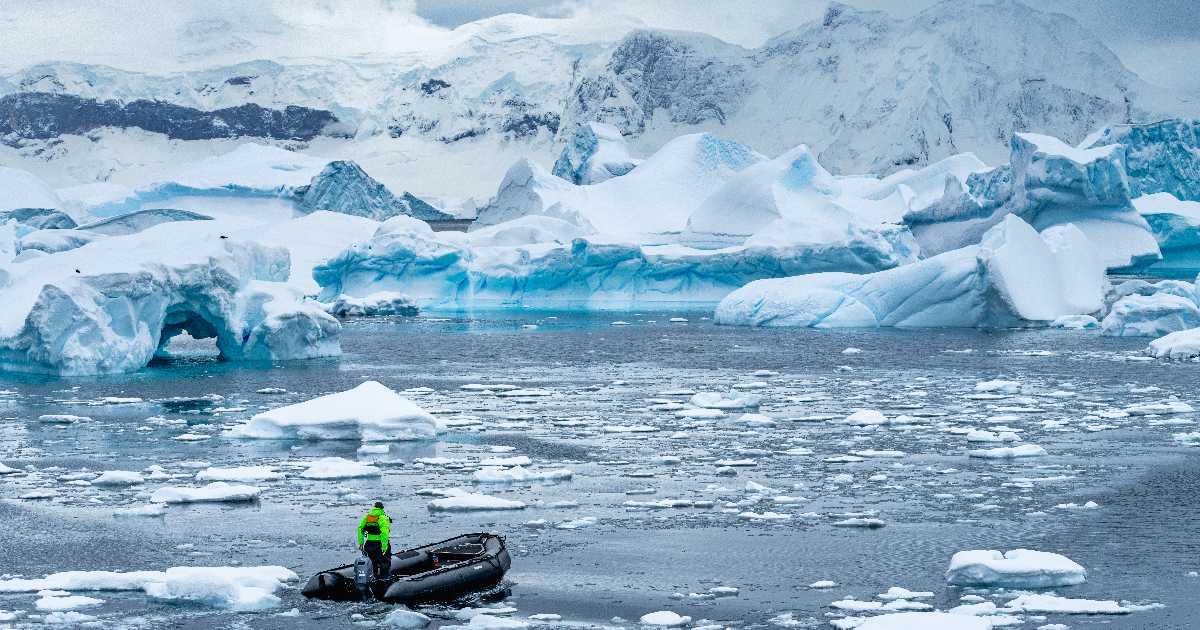
A person on a boat in front of a melting glacier.
This is the 20th report card of the Arctic released by NOAA, in a long-standing partnership with the Arctic Monitoring and Assessment Programme. The report card is compiled based on rigorous peer review, timely reporting, international assessments, and contributions of indigenous communities. The soaring temperature on the scale is snatching the snowy shield of the Arctic, causing it to crumble day after day. The crumbling has amplified in the last decade.
In March 2025, sea ice reached the lowest annual maximum extent in the 47-year satellite record. Greenland Ice Sheet, the largest ice mass in the Northern Hemisphere and second-largest in the world, lost an estimated 129 billion tons of ice in 2025. Don’t even talk about the “rusting rivers.” As thawing permafrost liberates metals like iron from the soils, these metals seep into the rivers, giving them a bizarre orange-red color. The problem is not the changing color. The problem is the fact that heavy metals dissolved in the rivers make life difficult for everyone, humans and the Arctic's wild animal dwellers.
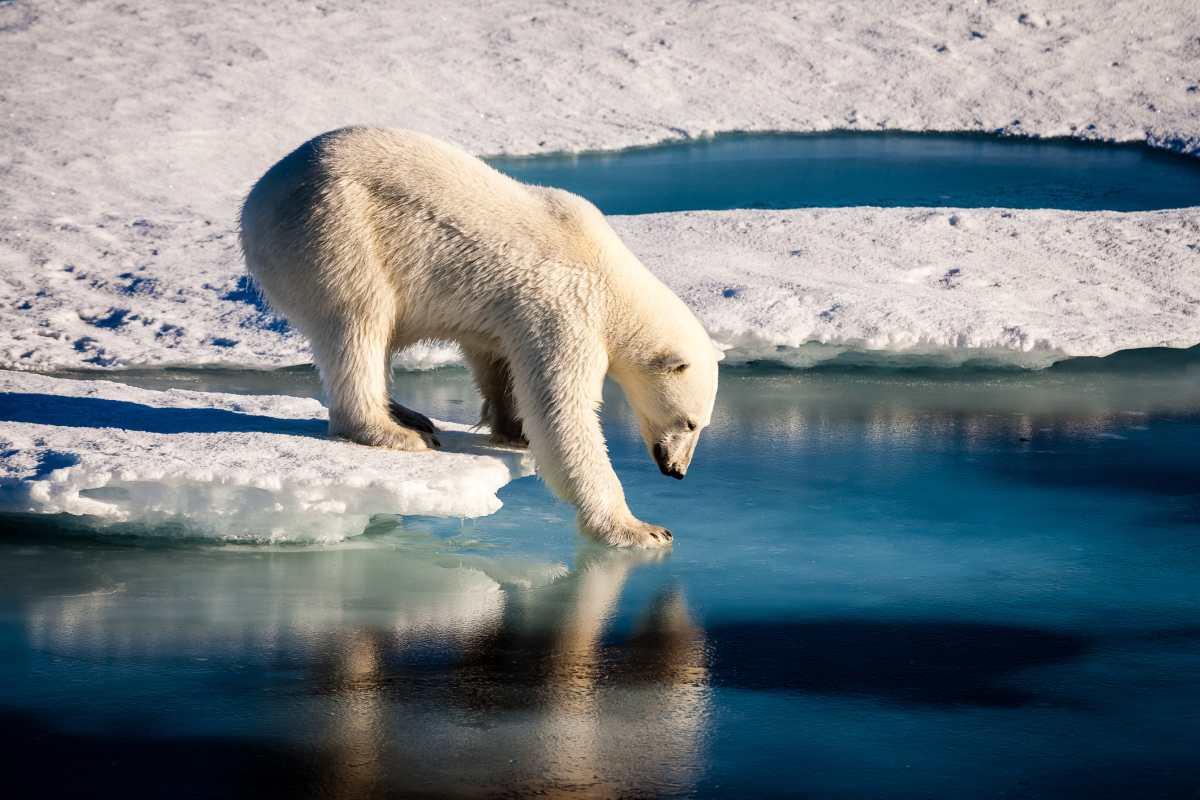
Polar bear touching the surface of sea ice
The list of negatives might be overwhelming, but some positive points should not be overlooked. The productivity of phytoplankton increased by 80% in the Eurasian Arctic, 34% in the Barents Sea, and 27% in Hudson Bay from 2003 to 2025. Some regions in the Pacific sector, like the Beaufort and northern Chukchi Seas, were cooler than average by 1-2°C (1.8-3.6°F). The maximum Arctic tundra greenness this year was the third highest in the 26-year satellite record.
Zack Labe, a climate scientist at Climate Central, said, "We are seeing cascading impacts from a warming Arctic. Coastal cities aren’t ready for the rising sea levels, we have completely changed the fisheries in the Arctic which leads to rising food bills for sea food. We can point to the Arctic as a far away place but the changes there affect the rest of the world." Scientists continue to monitor and record the changing performance of the Arctic’s machinery; it’s the integration of both the positives and negatives that will ultimately define the planet’s future. Will the “world’s refrigerator” continue to be a cooling system for the planet, or will it become warmer and warmer? Only time will tell.