
Two Suns Light Up Russia's Skies as Rare ‘Sun Dog’ Phenomenon Stuns Viewers
Published Jan. 26 2026, 6:03 a.m. ET

A white landscape blanketed in snow and a sundog, an optical phenomenon characterized by rainbowy patches of concentrated light
A video shared on Reddit shows a man getting dressed for work. Instead of walking towards the front door, he walked back into the room. Crouching his body through an open window, he jumped into what looked like an unfathomable abyss of white. Residents are forced to adopt tactics like these as Russia becomes buried under an unthinkably thick blanket of snow that has draped even four-story apartments. People are digging tunnels and underground staircases through banks of snow to reach their rooftop houses.
Cars have turned into ghosts as they are abandoned under dense mantles of snow. Streets are paralyzed, and shoreline sands are stopped dead with frozenness. This is the heaviest snowfall Russia has experienced in nearly six decades, per BBC. Shops are running out of bread, milk, and eggs, and residents are trapped. But even this depressing period of isolation and shutdown hasn’t prevented nature from expressing its creativity.

Cars, streets and buildings engulfed in blankets of snow
Residents in Russia’s Sakhalin region and Kamchatka reported catching sight of an almost mystic phenomenon that seems to be disobeying a cardinal law, that Earth has only one Sun. The new sight has left people disoriented by showing multiple Suns. These false twins are following the original Sun like a dog following its master. Sundog, that’s what scientists call it. Meteorologists believe that the intense cold, coupled with heavy humidity and recurring storms slapping these regions since December 2025, may have contributed to the materialization of these sundogs, according to a report by MinuteMirror.
Also known by terms like “mock Sun” or “phantom Sun,” a sundog is characterized by bright spots at an angle of 22 degrees on one or both sides of the Sun, like fleeting pillars of rainbowy light or two iridescent dancers performing sky dances around the Sun. Another fitting description known for this phenomenon is “parhelion,” a Greek word composed from a mix of para, meaning “beside,” and helios, meaning Sun. While a sundog itself is purely magical, there is a whole lot of science backing its appearance.
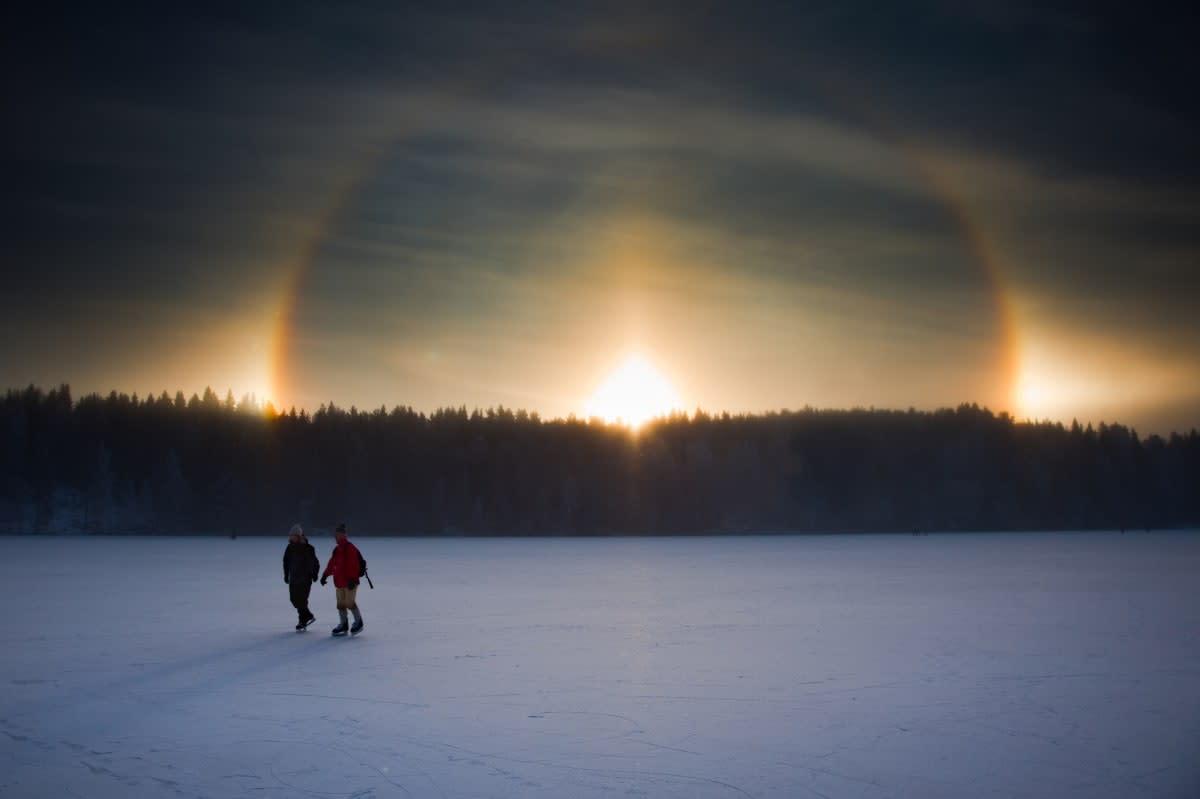
Two people walking in a field blanketed in thick snow while a glinting sundog shines in the sky above
The US National Weather Service explains that light is nothing but electromagnetic radiation. When it passes through a prism, it breaks itself down into different colors, which appear as bands of colorful light. The extremely cold weather conditions of Sakhalin and Kamchatka abruptly triggered this process, further supported by the stinging cold winds. The cold caused the skies of Russia to become peppered with zillions of tiny-tiny hexagonal ice crystals. The colder it became, the closer these ice crystals came to each other, eventually forming a blanket of ice mirrors a.k.a. diamond dust. When sunlight passed through this close-knit blanket of crystals, some of its light crossed through the crystals’ edges, while some of it bent. As a result of this refraction, two formations of colored light materialized near the Sun, which people identified as sundogs.
Space.com describes that the inner edges of sundogs, the ones closer to the Sun, are usually reddish, while the outer edges are blue. The middle typically holds colors in the yellow-orange palette. It depends on how the light scatters upon crashing into the crystals. Sometimes, these dogs appear with “tails” of light wiggling out of them. These tails are generated by reflection of light from the vertical sides of the hexagonal ice mirrors. A sundog is not to be mistaken for a halo. The two are different, according to the weather service. While a halo includes a ring of light outside the Sun plus the colored bright spots that appear within it, a sundog is named for only the bright spots and not the ring portion.