
Students Drop Baited Camera in Atlantic Ocean — and the Footage Reveals an Unusual Scene
Published Jan. 21 2026, 4:23 a.m. ET

Atlantic spotted dolphins captured by the camera. (Cover Image Source: University of Exeter, Centre for Ecology and Conservation (Penryn based))
A group of students came face-to-face with the wondrous world underwater during a field trip in the Azores, an archipelago in the mid-Atlantic. The group put a BRUV (baited remote underwater video camera) inside the waters every day. Their objective was to see the activity underneath the Atlantic Ocean, and it is safe to say from the footage that they weren't disappointed. Some beings they were able to detect in the footage include Atlantic spotted dolphins and a large blue shark. According to Discover Wildlife, Phil Doherty, a marine conservation science lecturer at the University of Exeter, believes that they were lucky with the timing of their deployment, as there was a considerable amount of activity in those days.
The students involved in the pursuit were all undergraduates from the University of Exeter. They aimed to record some local predatory fish from the region, but they ended up capturing much more. One day, they gathered 10 minutes' worth of footage, where they were graced with visuals of a pod of dolphins and at least one shark. The footage clearly showed that the creatures were comfortable with the lens. They were not scared and went about their normal routine. Doherty claimed that they were able to detect an umpteen number of clicks and whistles from Atlantic spotted dolphins, even before they made an appearance in the video.

A pod of dolphins was spotted. (University of Exeter, Centre for Ecology and Conservation (Penryn based))
The pod of dolphins seemed to be playing with each other for a while, after which they moved out of the frame. Then came the big shark. This moment was exciting for the team, as they set out to capture a predator like the shark. Doherty recalled that "all went quiet" when the blue shark made its entrance. Unlike the dolphins, the team did not detect any sounds before the shark's arrival. As per the lecturer, the creature "appeared out of the blue." The shark appeared to be scratching itself on the rig and observing the bait.
Though the team was fascinated by the footage, experts weren't surprised by the range of species the camera managed to capture. Doherty explained that despite being a remote location, the Azores boasts a high density of seamounts. The presence of these seamounts leads to the creation of biodiversity hotspots, which are appealing to massive migratory species. As far as marine vertebrates like whales and dolphins are concerned, the mixture of different ocean currents makes the archipelago an attractive spot.
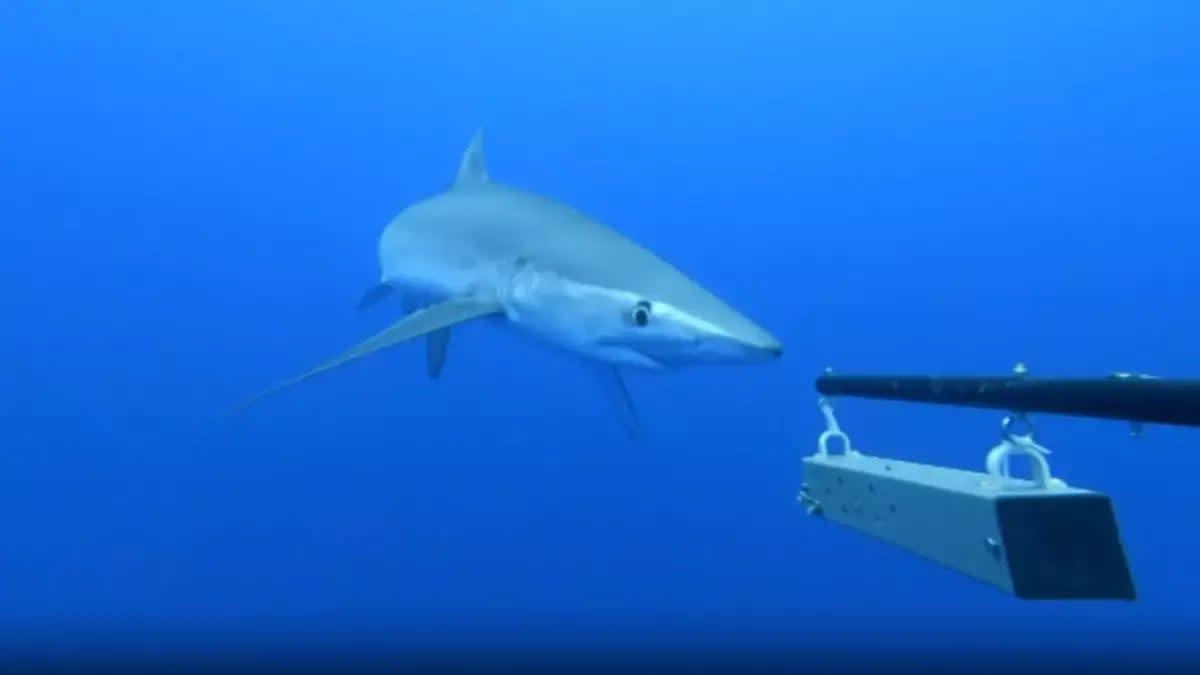
Shark in the footage (Image Source: University of Exeter, Centre for Ecology and Conservation (Penryn based))
Several cetaceans live prosperously in the nine islands that make up the Azores, according to WCA. One-third of all cetacean species in the world are found in the Azores. This makes the archipelago one of the richest areas in the Atlantic and possibly the world with respect to cetaceans. These 28 species include 21 toothed whales and 7 baleen whales. Creatures like sperm whales, common dolphins, Risso's dolphins, and bottlenose dolphins are spotted throughout the year in the area. One of the stars in the footage gathered by the students, the Atlantic spotted dolphin, is just a seasonal visitor. A massive area around the archipelago is under some sort of protection to protect these precious species.
Officials have taken advantage of this richness by organizing multiple cultural and socio-economic activities centered around these cetaceans. These pursuits include whale watching tourism activities and some historic whaling practices.