
Deer Marks Leave Trees Glowing in the Dark— Scientists Say They’re ‘Signposts’ for Mates
Published Jan. 8 2026, 9:07 a.m. ET

A fresh scrape seen in a flashlight (L). The leaves are still wet with deer urine on the left and lower edge of the scrape. A UV light revealed the urine as milky white.
During the mating season every autumn, the male whitetail deer walk around the forest, leaving marks that would tell the females nearby that a charming gentleman is roaming around there. When the sky dips in twilight, the deer vigorously rakes his antlers under a tree, licks the branch, and shreds it until the cambium layers inside are exposed. With his testosterone levels dancing in an upswing, he would go to great lengths to attract a mate. He rubs his foreheads against the exposed wood to leave behind perfume. With his hooves, he scrapes the ground to clear away vegetation. He digs up a depression in the soil and urinates, leaving a puddle for additional scent. Unlike humans, deer are attuned to ultraviolet light, so these markers act as natural lanterns or advertisements for potential mates. In the dark, these markers emit a bluish glow, sending signals to the females that the elusive gentleman is ready to mingle.
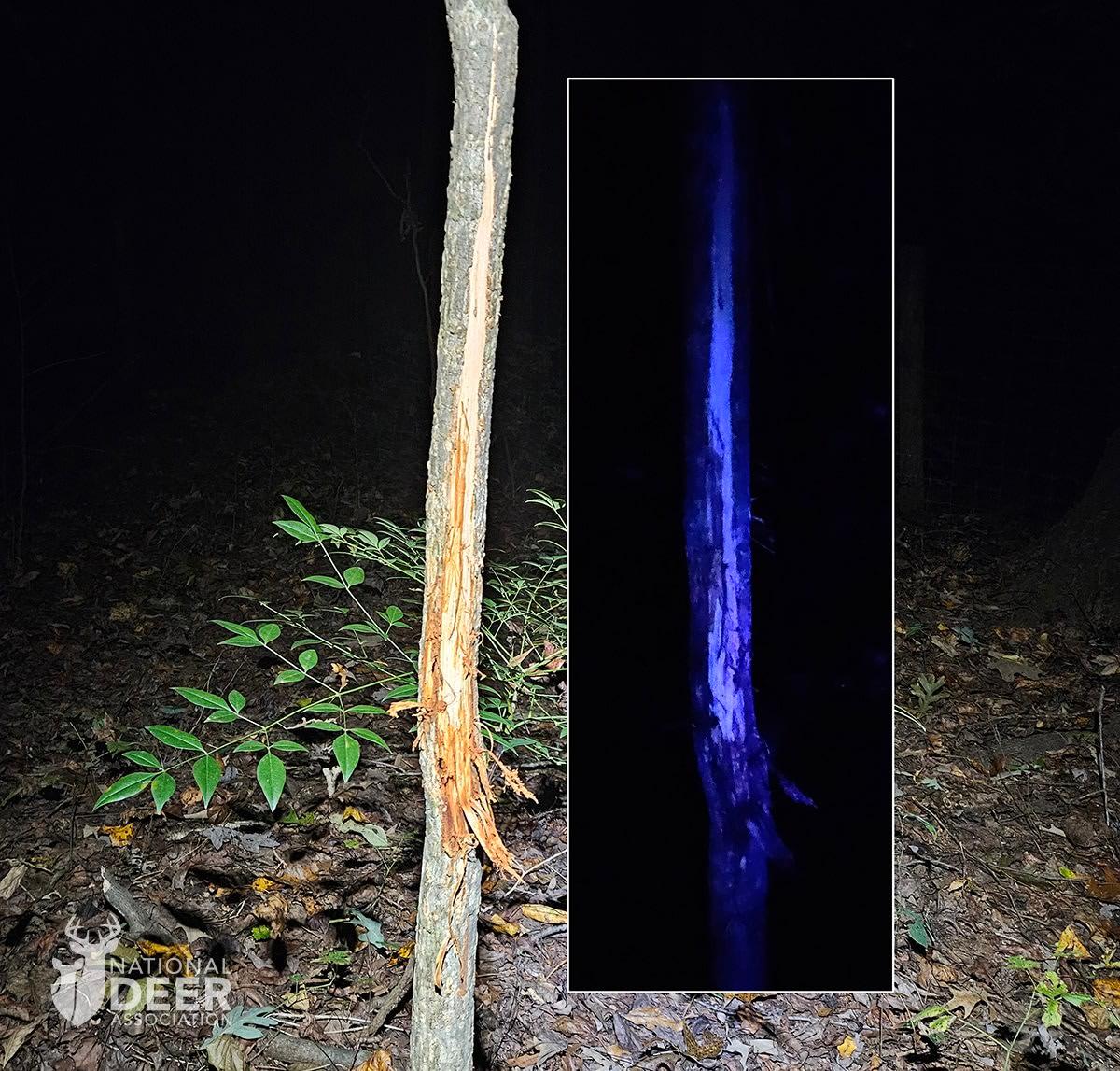
A fresh rub on a winged elm tree seen in a flashlight (L) and in 395 nm UV light (inset).
In a new study published in Ecology & Evolution, researchers from the University of Georgia documented their understanding of this phenomenon, also called photoluminescence. They curated this understanding after studying various markers left by whitetail deer using ultraviolet torches and sensors. They called these markers “signposts” in the disturbed soils. Photoluminescence is when organic material absorbs light and then re-emits it, but at longer wavelengths, hence making UV light visible to us.
Researchers combed through the 840-acre Whitehall Forest, located south of downtown Athens in Georgia, and investigated 146 signposts in late 2024. They exposed the signposts to two wavelengths of UV light and mimicked conditions of dusk and dawn when the deer are the most active. In total, they examined 146 signposts, including 109 antler rubs on trees and 37 scent-marking scrapes.

Male whitetail deer roaming in a forest surrounded by clusters of grassy bushes and flowers
Daniel DeRose-Broeckert, biologist and co-author, shared that he equates these markers to “highway reflectors.” His advisor, Dr. Gino D’Angelo, speculates that the markers are like “neon lights of the Honky Tonk Highway in Nashville,” per the National Deer Association. Not just the rubs and the scrapes, the glowing urine puddles are also fantastic.
These photoluminescent puddles, said Broeckert, glow like pools of white paint. Pretty striking, he remarked, wondering that female deer might be using these glowing cues to reach out to the deer and express their readiness to the deer. It’s a double advertising carousel. It’s not just the smell, but also the visuals. “You get stimulus from two senses,” explained Broeckert. “You have the sense of smell telling you something, and then, oh boy, it’s also superbright.”
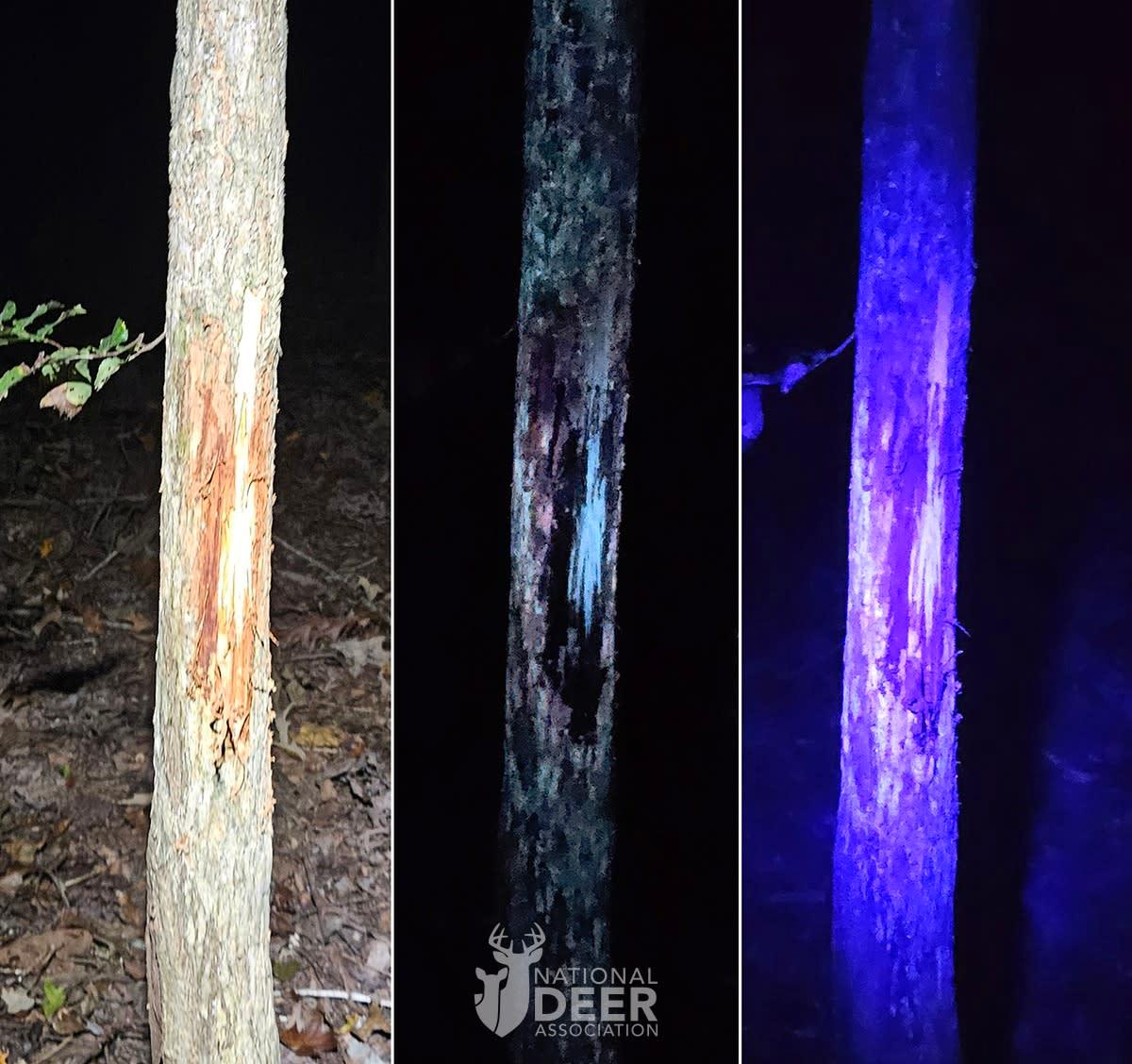
Another fresh rub on a winged elm seen in a flashlight (left), 365 nm UV light (center) and 395 nm UV light.
Another interesting observation that emerged from this research was the strange connection between the breeding season and the brightness of glowing signposts. Researchers realized that the glow of the trees became brighter as the breeding season progressed, which indicated the increasingly aggressive rubbing by the deer or more profuse secretions from their glands. Looking ahead, the research continues. Further studies will tell researchers how exactly the glow is formed, what chemical reactions spur this emission of light. In the future, they could manipulate the glow using chemicals to see how deer respond to human-induced signposts.